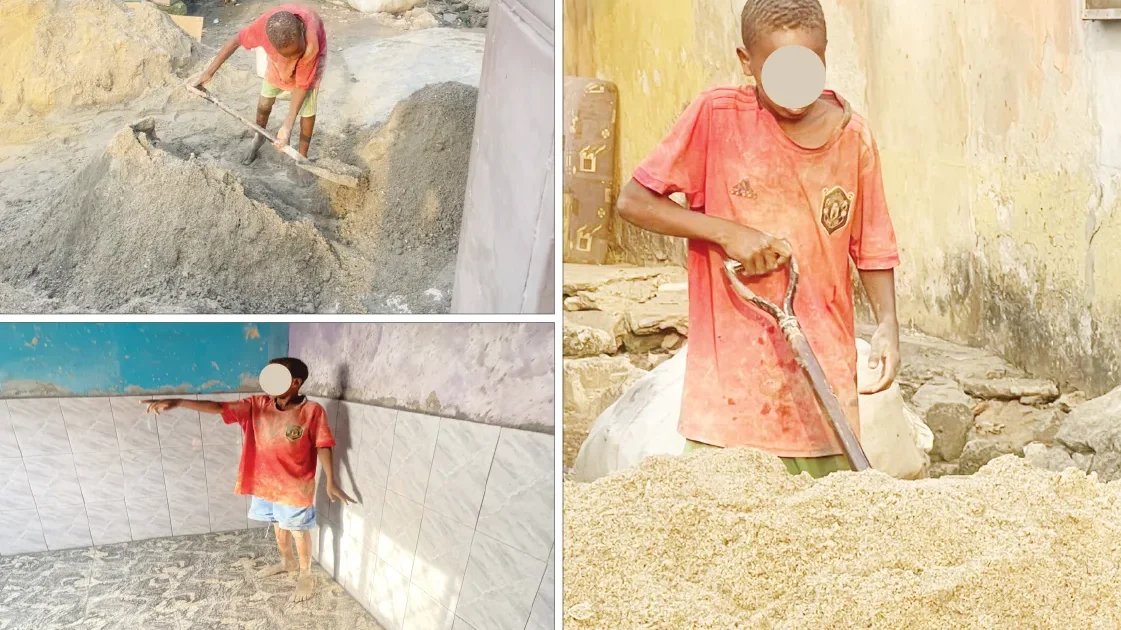
In Nigeria, a 10-year-old boy named Ojo Ibukun has traded his classroom for a construction site in Lagos. Ibukun, from the Benin Republic, is working as an apprentice under a tiler, Kilamuwaye Alexandre, who brought him to Lagos. The boy's daily routine involves carrying cement, mixing mortar, and sleeping on cardboard at an unfinished building. This situation raises concerns about poverty, migration, and informal apprenticeship leading to child labour.
Ibukun's journey to Lagos began when he expressed a desire to become a tiler instead of continuing with school. Alexandre described the arrangement as an apprenticeship influenced by the family's circumstances. Ibukun's parents agreed to let him accompany Alexandre to Lagos, where he could learn the tiling profession. However, Alexandre acknowledged that Ibukun was too young to be working on a construction site.
The apprenticeship system has a long history in Nigeria, including the Igbo apprenticeship system, commonly known as Igba-Boi. This model allows young people to learn trades and business skills by working closely with experienced masters. However, when the learner is a child, the situation becomes complicated. The International Labour Organization defines child labour as work that is harmful to children's well-being and development, interferes with education, or involves children who are too young to perform it.
Ibukun's circumstances raise questions about the difference between acquiring a trade and being removed from school to perform physically demanding work. He is not simply observing an experienced tiler but is actively involved in the construction process, carrying materials, mixing cement, and working on an active construction site. The building where he is learning a trade is also where he sleeps, with limited access to basic necessities like electricity and a proper bed.
Other workers at the construction site have confirmed that Ibukun's situation is not an isolated case. Koku Tosin, a tiler from Togo, has spent over a decade working in Lagos and has seen many cases like Ibukun's. Tosin attributed the trend to economic necessity, stating that small boys from the Benin Republic come to Lagos to do jobs due to limited opportunities in their home country.
The free movement of persons within ECOWAS member states has facilitated economic migration between Lagos and neighbouring countries. While this mobility is important for trade and livelihoods, it can create gaps in child protection when children move with adults into informal work arrangements that are difficult for authorities to monitor. As a result, children like Ibukun are exposed to informal work and exploitation.
The issue of child labour in Nigeria and across West Africa highlights the need for stricter regulations and monitoring of informal apprenticeships. Authorities must ensure that children are not exploited and that they have access to education and protection. Ibukun's story serves as a reminder of the complexities surrounding child labour and the need for a comprehensive approach to address this issue.
Key points
- Child labour is a significant issue in Nigeria, with many children being exploited in informal work arrangements.
- The free movement of persons within ECOWAS member states has facilitated economic migration, but also created gaps in child protection.
- Informal apprenticeships can be a form of child labour when children are exposed to hazardous conditions, work for long periods, or live at the workplace.