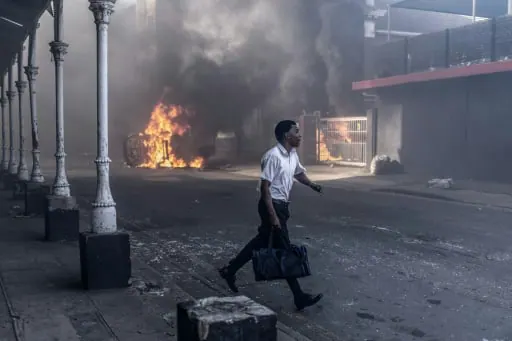
Clashes erupted between protesters and foreign nationals in Durban and Johannesburg on Friday, amid a second day of unrest targeted at foreign nationals. Large mobs moved through the city, kicking in shop windows and hurling bricks and bottles. The violence echoed weeks of protests that led thousands of nationals from other African nations to flee earlier this year. The protests were sparked by anti-migrant marches in Durban and Johannesburg against government orders for refugee reception offices to resume processing asylum applications.
The government had announced on Friday that it had withdrawn the instructions, which followed a Constitutional Court ruling, in an attempt to quell the anger. However, crowds of rioters, many armed with long sticks, moved through areas of Durban where students and foreign nationals live and work. Police fired tear gas and stun grenades to try to disperse the protesters. One migrant told journalists he was beaten and injured by South Africans who stole his wallet and phone, and was taken to safety by police.
Elsewhere, three houses were set alight and shops looted. A building was also set on fire in Johannesburg, where protesters marched to the offices of the Constitutional Court. At least 10 vehicles were set alight late Thursday in the Soweto district. President Cyril Ramaphosa told journalists that the government was dealing with the challenges unfolding in Durban and that the security cluster was on top of the situation.
The order to process asylum applications resulted in long queues of foreign nationals outside the centres, angering groups behind the push to force undocumented migrants to leave South Africa by a June 30 deadline. The Home Affairs Department said it had led to its offices being "overwhelmed within a matter of days" and "serious threats to public safety and order". The department's decision was met with resistance from populist groups leading demonstrations.
These groups accuse migrants of taking jobs and services from locals, a key issue for local government elections on November 4. The issue of migration has been a contentious one in South Africa, with periodic outbreaks of xenophobic violence for nearly two decades. Some claim that foreign nationals take scarce jobs and resources from locals, although this claim is disputed.
At least four foreign nationals have been killed in violence this year, according to the South African police, though some African governments said the toll was higher. The largest numbers of foreign nationals to leave were from Zimbabwe and Malawi. Nationals of Ghana, Kenya, Lesotho, Mozambique, Nigeria, and Uganda also fled, some repatriated by their government and raising diplomatic tensions.
The violence has sparked concern from the government, with President Ramaphosa urging calm and promising that the security cluster would work to prevent any loss of life. The situation remains volatile, with protests and clashes reported in several areas. The government has called for calm and urged citizens to respect the rights of all individuals, regardless of their nationality.
Key points
- The protests were sparked by anti-migrant marches in Durban and Johannesburg against government orders for refugee reception offices to resume processing asylum applications.
- At least four foreign nationals have been killed in violence this year, according to the South African police.
- The largest numbers of foreign nationals to leave were from Zimbabwe and Malawi.