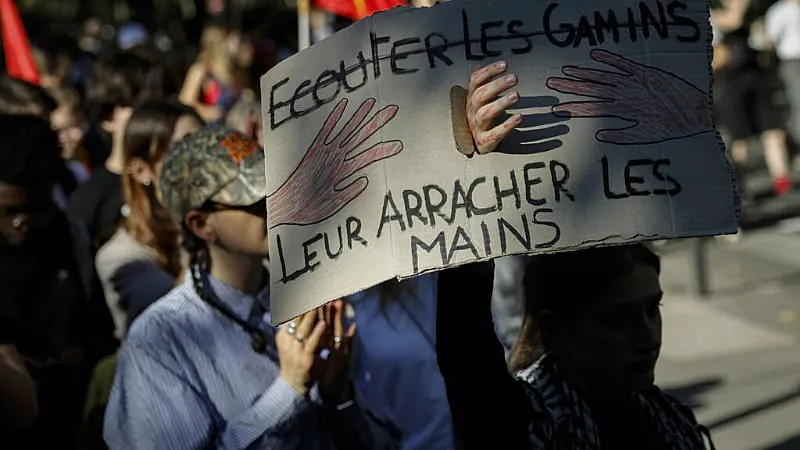
Mass protests swept across France's high schools on Tuesday, with hundreds of thousands of students joining the biggest day of the movement so far. The demonstrations began in late September, sparked by a handful of teachers at Saint-Exupéry high school in Créteil, a southern Parisian suburb, who went on strike to lament staff shortages. A student at the school told France Inter that they were "asking for the bare minimum." Their demands struck a chord with other high schools across the nation, which are suffering from a lack of funding and understaffing.
The protests are centered around several key issues, including staff shortages, run-down buildings, and long hours. Students are demanding a large-scale recruitment drive to create additional teaching posts so that each classroom has a person to lead it. They also want to ensure that every establishment has at least one nurse, a psychologist, and a career adviser for every 500 students. According to a major trade union representing public school staff, more than half of France's middle and high schools lack at least one teacher, and 69 percent of schools are short of at least one member of their teaching and support staff.
The French government has responded to the protests, with Prime Minister Sébastien Lecornu ordering his ministers to tackle the students' demands and send in proposals by the end of the month. However, finding spare funds to implement educational reforms will be complicated, given heated debates over France's already strained 2027 budget. Education Minister Édouard Geffray had expressed optimism before the September start of the new academic year, insisting that teacher shortages would be "minimal" and that "all indicators" were that things were on track to be "much better" than in previous years.
The state of school buildings is another major concern for students, who have sounded the alarm on the dire conditions of their schools. A wave of viral Instagram videos posted by students showcased the deplorable state of their establishments, including flooded toilets, rats, and cockroaches scurrying through school corridors. Vice President of the Île-de-France region James Chéron rejected the criticism, saying that the region's €6.6 billion, 10-year plan covers almost every public high school and that nearly 400 of its 468 establishments are already new or renovated.
Students are also demanding improvements to their timetables, which they say are too long and disrupted. They point to a reform adopted in 2019 that allows high school students to choose specialisation courses in their final years as one of the reasons timetables can be disrupted. French students tend to spend fewer days in school than the OECD average, but they make up for that with longer school days. Lecornu has asked for improvements to timetables and independent study conditions to be reviewed with public school staff, student representatives, and even local transport authorities.
A union of high school and university students published a list of 10 "emergency measures" they say could serve as a basis for working with the government. High on the list is the issue of staff shortages, as well as the maintenance of school and university buildings. Students are asking that an "emergency plan" be implemented to renovate dilapidated buildings and adapt them to heatwaves by installing air conditioners or cooling systems. They also want the buildings to be well-insulated to face cold spells.
The protests show no sign of slowing, with students determined to push for reforms to address their concerns. Lecornu has acknowledged that "studying in run-down premises is an obstacle to education" and has tasked ministers with setting a timetable on urgent needs and clarifying who is responsible for what. The government will need to balance the students' demands with the country's strained budget, but students are hopeful that their voices will be heard.
Key points
- French students are demanding reforms to address staff shortages, run-down buildings, and long hours in schools.
- The protests have sparked a national conversation about the state of education in France and the need for reforms.
- The government has responded to the protests, but finding spare funds to implement educational reforms will be complicated.