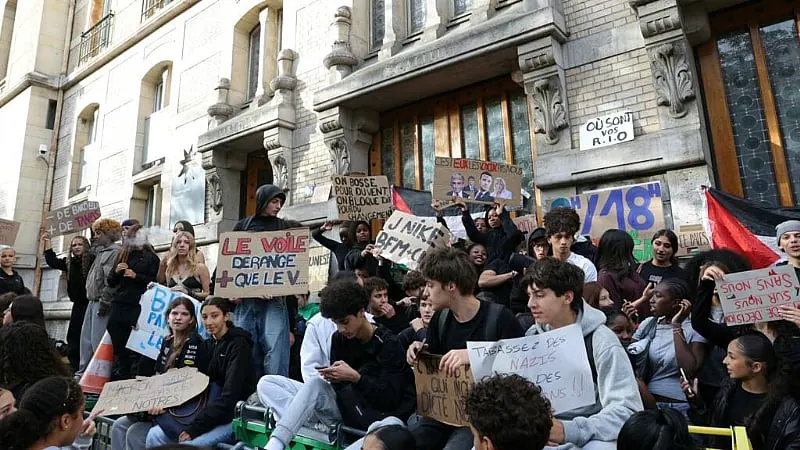
Student protests in France have entered their third week, with hundreds of schools remaining closed or blockaded amid increasingly violent demonstrations. On Friday, Education Minister Édouard Geffray met with student unions, parents' associations, and teachers' unions, but failed to provide concrete commitments to ease the protests. Louis Letoublon, vice-president of high school student union Les Lycéens, expressed disappointment with the talks, saying that the minister had listened but not offered any immediate solutions.
The protests, which began over concerns about school conditions, have resulted in 170 student injuries, 65 staff injuries, and over 5,000 arrests, mostly of minors. Geffray announced a new platform for students to share their grievances with policymakers and promised to address calls for absent teachers to be replaced, school buildings to be renovated, and timetables reviewed. However, Letoublon emphasized that the student movement would continue to mobilize to secure concrete action.
Student unions are urging pupils across France to participate in another day of demonstrations on October 6, dubbed "act three" of the movement. The success of the high school movement in maintaining momentum depends largely on its ability to find common ground with the higher education sector, according to historian Stéphane Sirot. Sirot pointed to the 2006 example, when a similar movement forced the government to scrap a labor reform.
While protests have taken place at some French universities, the movement remains largest in high schools. On Thursday, 222 secondary schools were blockaded, compared to 30 university campuses. Eloïse Lefebvre Milon, a leader of the Student Union, called on university students to stand with high schoolers, citing shared demands for a bigger budget for young people and an education that addresses the climate and social crises.
Several university student unions, France's largest federation of parents' associations, and at least six trade unions in the education sector have announced their support for the October 6 demonstrations. The movement is also gaining ground among younger children, with protests reported at around 100 middle schools on Friday. Lefebvre Milon emphasized that young people at secondary school and university will be the ones to tackle the climate and social crises.
Geffray assured pupils that they are being listened to, heard, and taken seriously, but the student movement remains skeptical about the government's willingness to implement change. Letoublon acknowledged that the minister had listened but said that concrete commitments were needed to ease the protests. The student movement is seeking to maintain leverage and secure action through continued mobilization.
The protests have resulted in severe damage to over 100 secondary schools, with 400 schools closed in total. The student movement's ability to sustain momentum will depend on its ability to build a broader coalition with the higher education sector and secure concrete commitments from the government. The October 6 demonstrations will be a crucial test of the movement's strength and determination.
Key points
- 170 students injured since the start of the protests
- 5,000 people arrested since protests began, mostly minors
- Student unions call for another day of demonstrations on October 6