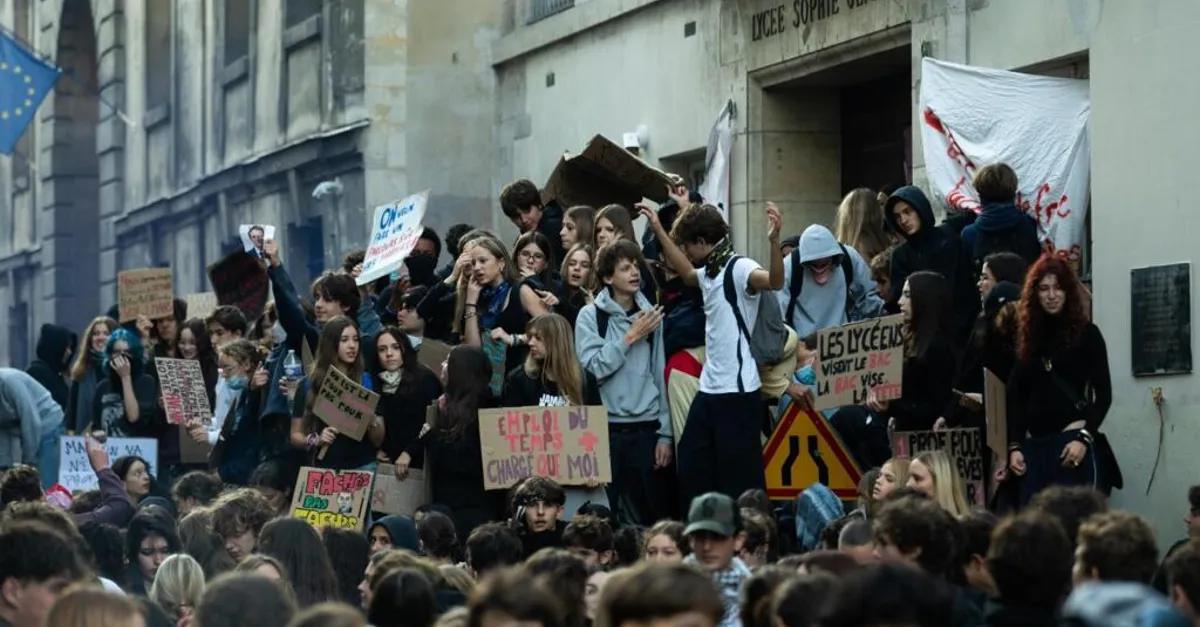
The ongoing French student protests have evolved into a complex crisis, extending beyond a simple wave of anger. The protests have roots in overcrowded classrooms and have spread to European financial markets. Experts, including Dr. Abdel Ghani Al-Ayadi, a consultant in the European Parliament, and Dr. Manal Khalifa, a member of the French Renaissance Party, have discussed the dimensions of a crisis that is increasingly concerning European capitals ahead of the 2027 French presidential election.
Dr. Manal Khalifa acknowledged a genuine structural flaw in the French education system, citing a shortage of teachers, overcrowded classrooms, and poor infrastructure. These issues were highlighted in a report by the OECD, which focused on working conditions in education. However, she distinguished between the real problem and its political exploitation, noting that the French Unbowed movement, led by Jean-Luc Mélenchon, has transformed this legitimate anger into a field of conflict. President Emmanuel Macron has clearly rejected transforming the protest into confrontation or violence.
Dr. Al-Ayadi views the protests of "Generation Z" as symptoms rather than the disease, expressing legitimate concerns about a generation burdened by debt and a high cost of living. However, these concerns are fueled in the context of a presidential campaign that invests in anger more than it provides answers. Dr. Manal concluded that the ruling Renaissance Party's position is based on a two-part equation: addressing the actual educational shortcomings and maintaining state authority while rejecting sabotage.
On the level of solutions, Dr. Manal sees the announced increase in the education budget for 2027, amounting to 1.1 billion euros, as a crucial step but insufficient on its own. She emphasized that France already spends 199.2 billion euros annually on its education system, which is 6.7% of its GDP. The question, she argues, is not how much is spent but how it is allocated. She called for prioritizing teacher salary improvements, working conditions, and development of their administrative burdens and training.
Dr. Al-Ayadi warned that the French crisis goes beyond protests, revealing a growing inability to produce stable political decisions under simultaneous financial and social pressures. He supported his analysis with strict numbers, pointing to a public debt of 3596 billion euros, or 119% of GDP, and a targeted deficit of 5% in the 2027 budget. Market signals are also cause for concern, with the difference between French and German bond yields exceeding 120 basis points for the first time since the 2012 crisis.
The experts agree that the next phase will be the most critical, with Dr. Manal warning that the real danger is not the transformation of protests into a comprehensive crisis like 1968 but their accumulation with pressures on purchasing power, erosion of public services, and political polarization. Dr. Al-Ayadi sees the French crisis as revealing a flaw in the structure of power, not its size, as France's economy, institutions, and military capabilities remain solid.
The crisis has already impacted major European files, including negotiations on the European financial framework 2028-2034, which amounts to nearly two trillion euros, and support for Ukraine, which is discussing the mobilization of up to 100 billion euros. However, Dr. Al-Ayadi remains hopeful that the months leading up to the elections are enough to break this vicious cycle, starting with the approval of a reasonable 2027 budget that restores some confidence in markets and partners.
Key points
- French student protests reveal deep-seated issues in education and pose challenges to President Emmanuel Macron's leadership ahead of the 2027 presidential election.