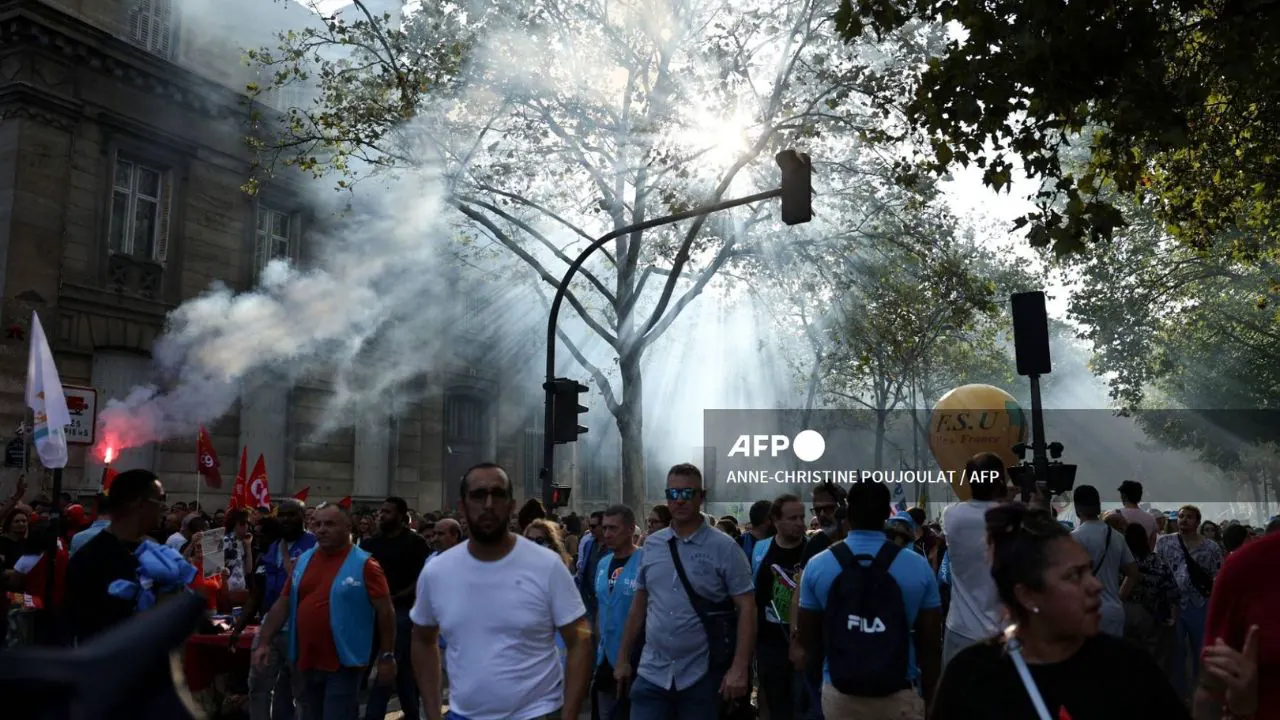
Tens of thousands of French public sector workers took to the streets on Tuesday to protest against low wages and declining purchasing power. The protests, which were organized by a coalition of unions, drew large crowds in cities across France, including Paris, Lyon, and Marseille. Protesters carried signs calling for higher wages and better working conditions, with some chanting slogans like "Increase salaries!" and "Block prices!"
According to the CGT union, over 300,000 people participated in the protests nationwide, with 70,000 of them in Paris. The French Interior Ministry put the number of protesters at 206,000, with 30,000 in the capital. The protests were marked by a strong presence of firefighters, who have been under strain due to a series of devastating wildfires this summer. In Paris, firefighters marched through the streets, carrying signs that read "We need means, not miracles."
The protests were sparked by the French government's decision to freeze the index point used to calculate public sector wages, which has not been increased since 2023. Unions have denounced the erosion of public sector workers' purchasing power, which has been exacerbated by inflation. Christelle El-Anraoui, a nurse from Chartres, said she was protesting to demand "more means from the government" and to highlight the deteriorating working conditions in the public sector.
The protests drew a diverse range of workers, including teachers, healthcare professionals, and laboratory technicians. Nine Martin, a 26-year-old production assistant at a theater in Bobigny, said she was protesting to defend public services and to demand better wages. Joëlle, a 57-year-old laboratory technician, said she was protesting for the first time in her life, citing the need for collective action to address the decline in purchasing power.
The unions have called for a significant increase in public sector wages and better working conditions. Sophie Binet, the leader of the CGT union, issued a warning to the government, saying that workers would not tolerate further declines in their purchasing power. Marylise Léon, the leader of the CFDT union, said that the protests were a call to action to defend public services and to demand better wages and working conditions.
In some cities, protesters blocked high schools and universities, highlighting the impact of budget cuts on education. The French Education Ministry reported that 338 schools were affected by the blockages. In Bordeaux, a history teacher said he was protesting to highlight the decline in teaching conditions and the impact on students. Yamna, a special needs assistant, said she was protesting to demand better wages and to highlight the precarious nature of her job.
The government has promised to review the index point used to calculate public sector wages, but unions remain skeptical. The protests are seen as a test of the government's willingness to address the concerns of public sector workers, who have been hit hard by inflation and budget cuts. The outcome of the protests and the government's response will be closely watched in the coming weeks and months.
Key points
- Over 300,000 French public sector workers protested across France on Tuesday.
- The protests were sparked by the government's decision to freeze the index point used to calculate public sector wages.
- Unions have denounced the erosion of public sector workers' purchasing power, which has been exacerbated by inflation.