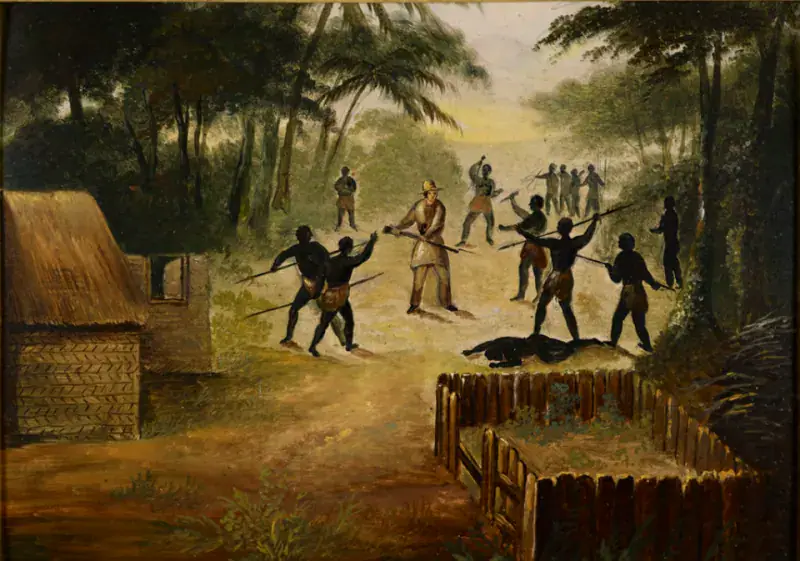
Le Temps, a French newspaper, has published an article reflecting on the 200-year-old 'Black War' in Tasmania, then known as 'Terres de Van-Diemen'. The article comes four years after England declared martial law against the indigenous Aboriginal population. The 'Terres de Van-Diemen' refers to the current Tasmania region, where the United Kingdom had established a colony in the early 19th century.
The British established their presence in Tasmania as European powers competed for colonies. The French press aimed to present the territory and justify its colonization. However, the British colonial power faced challenges in the 1820s, with relations between the colonizers and native populations oscillating between distance, collaboration, and conflict.
Tensions escalated in 1826 when Governor George Arthur called for the capture of Aboriginal individuals to end clashes. Instead, a prolonged guerrilla war between military forces and Aboriginals began. Two years later, martial law was declared, leading to the gradual massacre of the indigenous population.
French journalists used the conflicts to temper British colonial dominance. However, their interest lay more in contesting the legitimacy of British colonial authorities than in liberating the Aboriginals. Le Temps dedicated several columns to the situation in Tasmania in 1832, highlighting economic opportunities, racist descriptions of the colonized, and criticism of British management.
The article described Tasmania's geography, climate, and natural resources. Located between 40° 42' and 43° 43' south latitude and 145° 31' and 148° 22' east longitude, Tasmania was separated from the Australian continent by the Bass Strait. The island was discovered by Abel-Jansz Tasman in 1642 and named after Antoine Van-Diemen, the governor-general of Dutch possessions in the East Indies.
The climate in Tasmania was described as temperate, with the highest mountains covered in snow and valleys where snow disappeared within hours. However, frosts persisted until spring, especially in the upper parts of the island. The average temperature in low-lying areas was around 60 degrees, with no extreme temperatures or rainfall.
Le Temps also described the native population, numbering around 600, as timid and of the 'negro race', similar to those in New Holland. They were characterized by thin limbs and large heads. The article portrayed a strained relationship between the natives and European colonizers, who had treated them with barbarity, leading to a deep-seated hatred.
Key points
- The British colonization of Tasmania was marked by conflict and violence against the indigenous Aboriginal population.
- French newspaper Le Temps published an article in 1832 reflecting on the situation in Tasmania, describing its geography, climate, and strained relationships between colonizers and natives.
- The native population of Tasmania was estimated to be around 600 and was described as timid and of the 'negro race'.