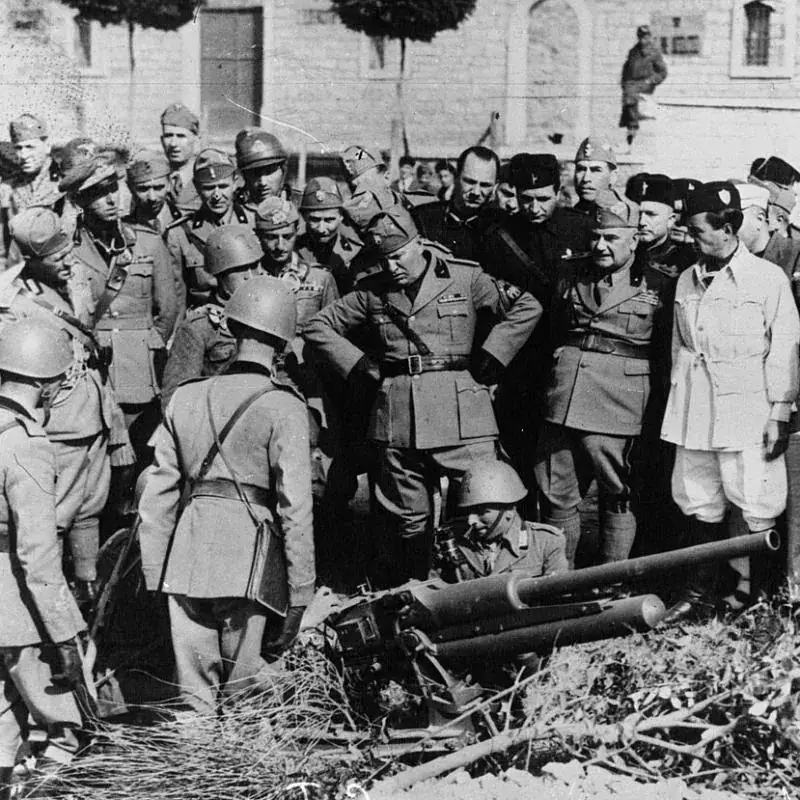
On November 3, 1936, Italian dictator Benito Mussolini delivered a speech in Milan, Italy, outlining his country's foreign policy and announcing a rapprochement with Nazi Germany. The speech, which lasted nearly an hour, was met with varied reactions from the French press. Mussolini's words were seen as a significant shift in Italy's stance on international relations, particularly in light of the country's recent conflict with Ethiopia and the subsequent sanctions imposed by the League of Nations.
The French press was divided in its response to Mussolini's speech, with some outlets praising the Italian leader's assertiveness and others expressing concern over the implications of his words. Le Courrier de la Rochelle, for example, published an article titled "Sacred Egoism," which echoed Mussolini's sentiments and argued that France should prioritize its own interests over international cooperation. The article's author praised Mussolini's willingness to speak frankly about the self-interest of nations.
Other French publications, such as L'Action française, were even more effusive in their praise of Mussolini, hailing him as a visionary leader who understood the importance of preparing for the future. The newspaper described Mussolini's speech as "remarkable" and noted that his emphasis on working towards long-term goals was a hallmark of effective statecraft. This positive reception was not universal, however.
Some French newspapers expressed skepticism or outright criticism of Mussolini's speech and its implications for European politics. Le Sémaphore de Marseille, for instance, attempted to downplay the significance of Mussolini's words, suggesting that they did not pose a threat to the French government of the time. In contrast, L'Ouest-Éclair saw Mussolini's speech as a direct rebuke to France.
L'Ouest-Éclair argued that Mussolini's comments were a manifestation of "ingratitude" towards France, which had previously supported Italy during a time of crisis. The newspaper also linked Mussolini's speech to the perceived weaknesses of the French government, particularly the influence of the Communist Party. According to L'Ouest-Éclair, France needed to reassess its internal politics in order to project a stronger image abroad.
Not all French publications were swayed by Mussolini's rhetoric, however. Le Monde illustré, for example, took a more measured approach, choosing to contextualize Mussolini's speech and highlight the potential implications of his alliance with Hitler. The newspaper's analysis emphasized the need for caution and nuance in interpreting Mussolini's words.
The diverse reactions of the French press to Mussolini's 1936 speech reflect the complex and often contradictory nature of European politics during the interwar period. As Italy and Germany began to draw closer together, France and other European powers were forced to reevaluate their own positions and alliances. Mussolini's speech marked an important turning point in this process.
Key points
- Mussolini's 1936 speech marked a significant shift in Italy's foreign policy, as the country began to align itself more closely with Nazi Germany.
- The French press was divided in its response to Mussolini's speech, reflecting a range of perspectives on European politics and diplomacy.
- Mussolini's speech has been seen as an early step towards the formation of the Axis alliance between Italy and Germany.