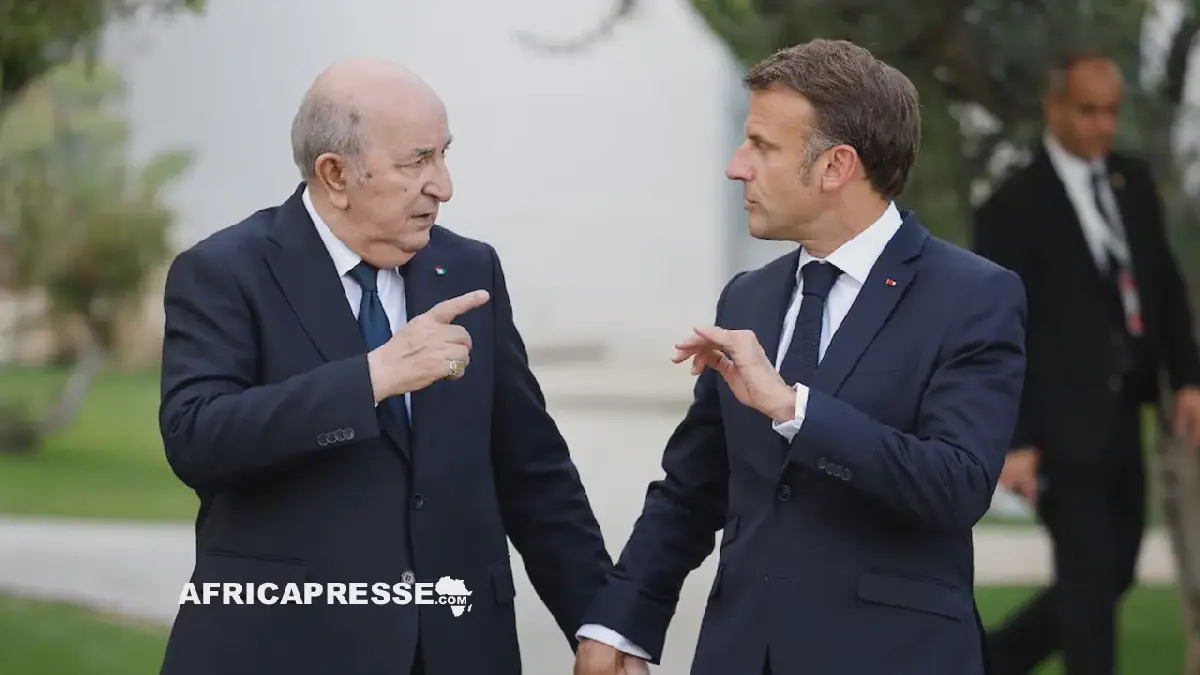
French President Emmanuel Macron has made a last-ditch effort to improve relations with Algeria by sending his diplomatic advisor, Emmanuel Bonne, and Romaric Roignan, director for North Africa and the Middle East at the Quai d'Orsay, to meet with Algerian President Abdelmadjid Tebboune on November 2. The meeting was held at the El Mouradia palace, and the envoys carried a "strong message" from Macron. This move aims to restart dialogue between Paris and Algiers, which have been experiencing persistent tensions.
Despite the resumption of official contacts in February 2026, several issues continue to hinder significant progress between the two countries. Algeria is demanding the release of its consular agent detained in France, while Paris is concerned about the situation of French journalist Christophe Gleizes, who has been imprisoned in Algeria for over 500 days. Economic tensions also exist, with Algeria instructing its authorities to boycott French imports. These disputes illustrate the depth of a crisis that goes beyond simple diplomatic exchanges.
The diplomatic mission takes place in a context of transition, with the upcoming departure of French Ambassador Stéphane Romatet, who has been in office since 2023 and is set to leave in 2027. Moreover, with the French presidential election approaching in 2027, Algeria prefers to wait and see who the new occupant of the Élysée will be. The positions of several potential candidates, including Marine Le Pen and Jean-Luc Mélenchon, have already raised questions among Algerian authorities.
The memorial issue has also not seen any progress, with the joint commission of historians responsible for issues related to colonization and the Algerian War remaining stalled, despite the recent presence of historian Benjamin Stora in Algiers. This mission appears more like an attempt to preserve communication channels than a genuine relaunch of bilateral relations. Macron wants to lay the groundwork for reconciliation, but Algiers seems to be reserving any new negotiations for his successor.
The Algerian side, with its wait-and-see attitude, does not intend to engage on structuring issues before knowing the outcome of the French election. This strategy allows Algiers to maintain pressure on Paris while avoiding premature concessions. For Paris, the goal is less to resolve the disputes than to avoid further deterioration of relations. The discretion of Bonne's mission reflects a desire not to publicize an approach whose results remain uncertain.
Observers of Franco-Algerian relations note that this approach is part of a continuity, with the two countries alternating between open crises and gestures of appeasement without ever reaching a lasting settlement of structural issues. The memorial question, in particular, remains a recurring point of contention, with the commission of historians having produced no significant progress since its creation.
Macron's approach is a diplomacy of last chance, driven more by the political calendar than by a genuine dynamic of reconciliation. Algiers, in a waiting position, is counting on the alternation in Paris to obtain better negotiation conditions. In the absence of breakthroughs on judicial, economic, and memorial disputes, this mission is unlikely to produce significant effects. However, it confirms that both capitals want to maintain a line of discussion, a minimum condition to avoid a definitive rupture.
Key points
- Emmanuel Macron sent a diplomatic envoy to Algeria in an attempt to preserve communication channels with the country before leaving office.
- Several issues, including the detention of a consular agent and a journalist, continue to hinder significant progress between France and Algeria.
- The mission's outcome is uncertain, and its success is unlikely given the complexities of the disputes between the two countries.