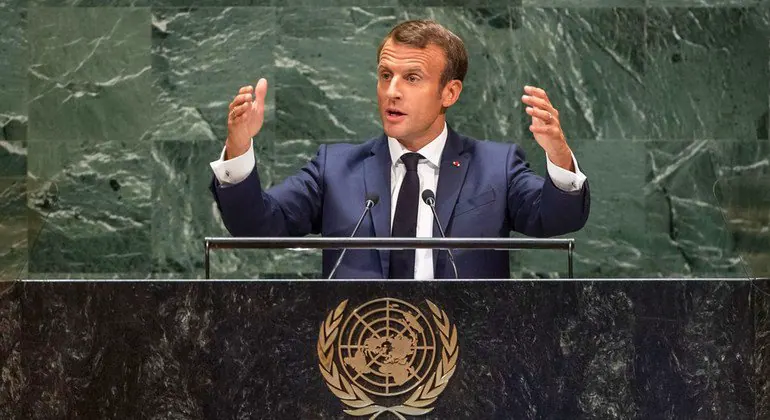
French President Emmanuel Macron recently addressed the United Nations General Assembly in New York, where he focused on the ongoing crisis in the Middle East. In his speech, Macron emphasized the importance of upholding international law, respecting state sovereignty, and protecting Palestinian rights. He expressed concern over the escalating conflicts in the region, including the situation in Gaza, the West Bank, Lebanon, Syria, and the Strait of Hormuz.
Macron strongly criticized the "industrialization of war crimes, violations of law, and destruction of civilian infrastructure" in the Middle East, Ukraine, and Africa, warning that this trend could lead to a new era of barbarism. He specifically highlighted the situation in Gaza, where ongoing diplomatic discussions have yet to yield a lasting peace. Macron argued that verbal commitments to peace are insufficient and that tangible action is needed to address the humanitarian crisis.
The French president also turned his attention to the West Bank, where he denounced continued violations that, in his view, hinder the construction of a political solution. Macron emphasized that the situation in the West Bank cannot be separated from the rights of the Palestinian people, stating that ongoing violations undermine the legitimacy of Palestinian rights to exist. He also recalled France's recognition of the State of Palestine, arguing that this move is not merely symbolic.
Macron responded to critics who view the recognition of Palestine as a largely symbolic gesture, asking, "But what is our credibility if we continue to remain inactive in the face of Gaza?" He reiterated France's commitment to Israel's security and existence while rejecting the idea that Israeli security can be ensured at the expense of neighboring countries' sovereignty. Macron emphasized that true security for Israel can only be achieved through respect for the sovereignty of its neighbors.
The French president also addressed the situation in Lebanon, stressing the need to restore the country's full sovereignty, particularly in the south, which has been marked by population displacement and destruction. Macron highlighted the importance of disarming Hezbollah, stating that only a fully sovereign Lebanon can ensure the group's disarmament and restore security for Lebanese citizens and neighboring countries.
Throughout his speech, Macron advocated for a three-pronged approach: respect for international law, state sovereignty, and Palestinian rights. He urged the international community not to accept the inevitability of war and to maintain a political perspective on the crises in Gaza, the West Bank, Lebanon, and Syria. Macron's speech reflects France's commitment to finding a lasting solution to the Middle East crisis.
Macron's address to the UN General Assembly underscores the need for collective action to address the complex challenges facing the Middle East. His emphasis on international law, state sovereignty, and Palestinian rights provides a framework for navigating the region's intricate conflicts. As the international community continues to grapple with these issues, Macron's speech serves as a reminder of the importance of sustained diplomatic efforts and a commitment to upholding human rights and international law.
Key points
- Macron emphasizes the need for respect for international law, state sovereignty, and Palestinian rights in the Middle East.
- The French president criticizes the "industrialization of war crimes" in the region and advocates for tangible action to address the humanitarian crisis.
- Macron reiterates France's commitment to Israel's security and existence while rejecting the idea that Israeli security can be ensured at the expense of neighboring countries' sovereignty.