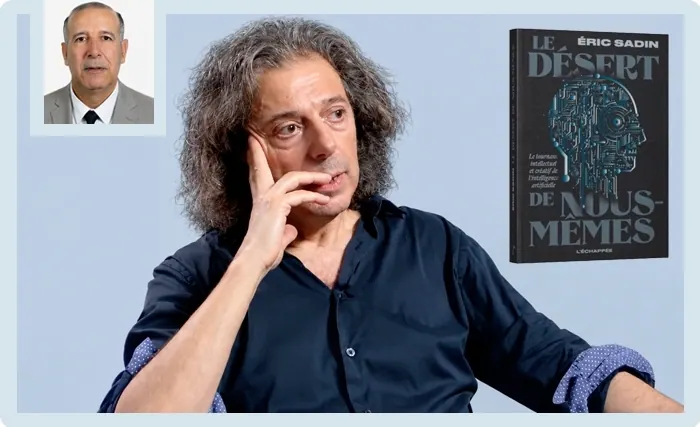
French philosopher Eric Sadin has published a book titled "Le Désert de nous-mêmes. Le tournant intellectuel et créatif de l’IA" (The Desert of Ourselves: The Intellectual and Creative Turning Point of AI), in which he explores the consequences of relying heavily on artificial intelligence. Sadin argues that the increasing presence of AI in daily life poses significant risks to human autonomy and society. He contends that as AI takes over fundamental human faculties such as language, symbols, and creation, individuals risk losing their sense of self and becoming isolated.
Sadin's work focuses on the impact of technology on human relationships and culture. He is critical of the Silicon Valley model and the rationalization of the digital world. His book is part of a trilogy that examines the effects of technology on society, including "La vie algorithmique" (2015), "La siliconisation du monde" (2016), and "L’intelligence artificielle ou l’enjeu du siècle" (2018). Sadin's latest work highlights the dangers of humans becoming too dependent on machines and losing their capacity for critical thinking and collective decision-making.
The launch of ChatGPT in late 2022, according to Sadin, marks a significant turning point in the relationship between humans and AI. He believes that AI is no longer just assisting humans but is taking over essential human functions, leading to a loss of autonomy and a state of "solitude interconnectée" (interconnected solitude). Sadin argues that this phenomenon is symptomatic of an inner impoverishment, where individuals become detached from themselves, others, and the real world.
Sadin's book has been praised for its well-documented and solidly argued thesis, despite its polemical and militant tone. He advocates for the preservation of critical thinking and collective decision-making, emphasizing the importance of creativity and intellectual curiosity. Sadin believes that humans must defend their capacity for anticipation and foresight, which are essential qualities that set them apart from machines.
The author's concerns about the impact of AI on human society are shared by many experts in the field. As AI continues to evolve and become more integrated into daily life, there is a growing need for a nuanced discussion about its consequences. Sadin's work contributes to this debate, encouraging readers to think critically about the role of technology in their lives.
Sadin's ideas have implications for various fields, including education, psychology, and philosophy. His work challenges readers to consider the long-term effects of relying on AI and to think about the kind of society they want to create. By highlighting the risks associated with over-reliance on technology, Sadin's book aims to inspire a more thoughtful approach to the development and use of AI.
Ultimately, Sadin's book is a call to action, urging readers to take a step back and assess the impact of technology on their lives. By doing so, individuals can work towards creating a more balanced relationship between humans and AI, one that preserves human autonomy and promotes a more meaningful and connected existence.
Key points
- Eric Sadin's book "Le Désert de nous-mêmes. Le tournant intellectuel et créatif de l’IA" warns of the risks of over-reliance on AI and its impact on human autonomy and society.