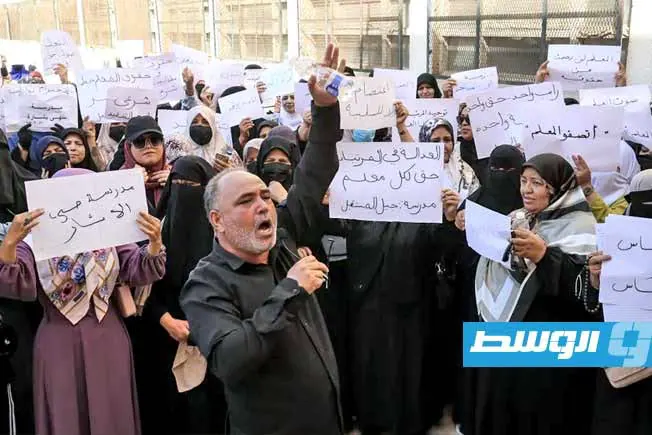
A French newspaper, La Croix, reported that the teachers' movement in Libya, which has been ongoing for over three weeks, has not prevented the country's two main cities, Tripoli and Benghazi, from addressing the crisis separately. The movement, which began on September 29, 2026, has seen teachers protesting for better working conditions, higher salaries, and improved healthcare. The protests have resulted in the closure of all government schools, affecting students in a country with a population of seven million.
The teachers' movement in Libya has gained significant support, with slogans such as "No education without dignity for teachers," "No health insurance, no return to classrooms," and "Verbal promises do not pay our bills." The movement is led by the General Union of Libyan Teachers, with its spokesperson, Ashraf Aburawi, stating that the movement came from the grassroots level, with teachers united in their demands. The union is demanding a unified salary scale, payment of delayed differences, and improved working conditions.
Libyan teachers currently earn between 1,000 and 2,500 dinars (approximately 140 to 350 euros) per month, which is barely enough to cover rent in Tripoli. The cost of living in Libya has increased significantly, and teachers often have to work second jobs to make ends meet. The movement has also highlighted the need for better-equipped classrooms, with students often crowded into overcrowded rooms.
Despite the challenges, the education sector has remained one of the few institutions that has maintained national cohesion since the fall of Muammar Gaddafi's regime in 2011. The General Union of Libyan Teachers is pushing for a comprehensive agreement that applies to all employees. The union's demands have gained support from various stakeholders, including the Libyan government.
The crisis in Libya has led to a significant gap between the country's resources and the majority of its population. According to researcher Virginie Colombier, the teachers' movement highlights the need for the government to prioritize public services and development. The movement has also sparked discussions about the need for a unified budget and the distribution of state wealth.
Tripoli and Benghazi have begun addressing the crisis separately, with the western government negotiating to integrate teachers into the national health insurance system and proposing a revised academic calendar. The eastern government, on the other hand, supports a unified salary scale but has referred the matter to the Central Bank.
The teachers' movement has sparked hopes for a resolution to the crisis, with researcher Virginie Colombier stating that the movement may force the government to reach an agreement. The movement has also highlighted the need for a unified approach to addressing the country's challenges.
Key points
- The teachers' movement in Libya has gained significant support and has highlighted the need for improved working conditions, higher salaries, and better-equipped classrooms.
- The movement has sparked discussions about the need for a unified budget and the distribution of state wealth in Libya.
- Tripoli and Benghazi have begun addressing the crisis separately, with the western government negotiating to integrate teachers into the national health insurance system and the eastern government supporting a unified salary scale.