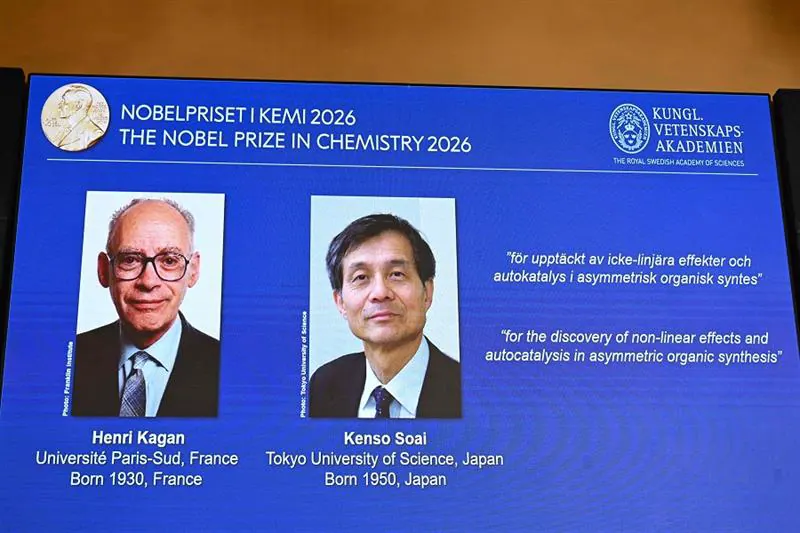
France's Henri Kagan and Japan's Kenso Soai have been awarded the Nobel Prize in Chemistry for their groundbreaking work on asymmetric organic synthesis. The duo was honored for their discovery of non-linear effects and autocatalysis in asymmetric organic synthesis, which has enabled chemists to drive chemical reactions that lead to homochirality. This phenomenon refers to the presence of only one version of some molecules' mirror-image forms in nature, a mystery that has puzzled chemists for over a century.
The Nobel laureates' work has been decisive for the development of pharmaceuticals, as it allows chemists to design reactions for the manufacture of complex molecules. According to Heiner Linke, chair of the Nobel Committee for Chemistry, Kagan and Soai have provided a solution to a chemical mystery that has been unsolved for over 100 years. Their discoveries have opened up new avenues for the synthesis of molecules, which is crucial for the development of new medicines.
The phenomenon of homochirality is observed in amino acids, which exist as two mirrored variants, but only one of them is found in the proteins in the body's cells. The other variant is rarely found in nature, and chemists have long wondered how this process occurs. Kagan and Soai's work has shed light on this process, enabling chemists to understand how homochirality can emerge spontaneously.
The Nobel Prize in Chemistry is one of the five Nobel Prizes established by the will of Alfred Nobel. The prize consists of a diploma, a gold medal, and a 12-million-kronor ($1.2-million) prize sum, which is shared if there is more than one winner in a discipline. Kagan and Soai will receive their prizes at a formal ceremony on December 10, the anniversary of the death of Alfred Nobel.
The Nobel Prize season continues with the literature laureate to be revealed on Thursday. Some pundits suggest that the Swedish Academy could follow up last year's award to Hungary's Laszlo Krasznahorkai with a prize for a woman writer, possibly from Latin America. The peace prize, which is one of the most keenly anticipated awards, is due on Friday.
The Nobel Prize in Physics was awarded on Tuesday to Belgian physicist Francis Halzen for his groundbreaking work using Antarctic ice to capture particles originating in the distant cosmos. On Monday, the medicine prize was awarded to US psychiatrist and neurologist Karl Deisseroth and German scientists Peter Hegemann and Georg Nagel. The economics prize wraps up the Nobel season on October 12.
The awards come at a time of great scientific discovery and innovation. The Nobel Prizes are widely regarded as the most prestigious honors in their respective fields, and Kagan and Soai's work is a testament to the importance of fundamental research in chemistry. Their discoveries have the potential to lead to breakthroughs in the development of new medicines and materials.
Key points
- French-Japanese duo Henri Kagan and Kenso Soai win Nobel chemistry prize for solving chemical asymmetry puzzle
- The duo was honored for their discovery of non-linear effects and autocatalysis in asymmetric organic synthesis
- Their work has enabled chemists to drive chemical reactions that lead to homochirality, a phenomenon that has puzzled chemists for over a century