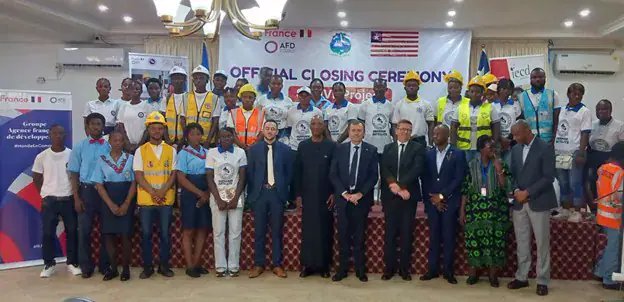
The Strengthening Integration Through Vocational Education (STRIVE) Project, funded by the French Development Agency (AFD) and implemented by the European Institute for Cooperation and Development (IECD), has formally closed in Liberia. The project, which began in July 2020, supported more than 2,000 young people in electricity, hospitality, masonry, and agriculture across four counties. The project's closure was marked by a ceremony attended by French and Liberian officials, as well as development partners.
French Ambassador to Liberia Dominique Pierre Delpuech emphasized the importance of technical and vocational education and training (TVET) in Liberia's economic and social development. He noted that TVET is part of the Government's ARREST Agenda for Inclusive Development and that it is crucial for addressing the country's employment and employability challenges. Delpuech also highlighted that young people make up roughly 75 percent of Liberia's population, presenting both an opportunity and a major responsibility.
Delpuech urged the Government of Liberia to take ownership of the project's gains, ensuring that infrastructure, equipment, and training programs are sustained in the long term. He emphasized that sustainability depends on the government's commitment and that the Ministry of Youth and Sports (MYS) and the Ministry of Education (MoE) have key roles to play in continuing STRIVE's activities. The ambassador also called for stronger links between training and the labor market, including an enabling environment for companies to take on interns and apprentices.
Elliott Sotty, representing AFD, credited partners for their work on the project and highlighted AFD's commitment of nearly €62 million in grants to Liberia since 2018. He noted that the €10 million STRIVE grant has become one of AFD's flagship interventions in human capital development. Sotty emphasized that the true measure of success is not the number of classrooms renovated or equipment delivered, but the skills acquired, opportunities created, and lives changed as a result.
Sotty also made a pointed appeal to the private sector, urging companies to be more directly involved in shaping curricula and identifying skills gaps. He called for more internships, apprenticeships, and work-based learning, enabling the transition to employment to begin during training rather than on graduation day. Additionally, Sotty raised the need for long-term financing, noting that quality training requires adequate infrastructure, modern equipment, qualified trainers, and regular investment in maintenance.
Alexandre Vial, IECD Country Director, outlined the project's reach, stating that STRIVE worked with training institutions, public authorities, employers, instructors, farmers, and young people to support practical skills development and economic inclusion. He noted that vocational education is strongest when learners can connect what they study with what they can do. According to Vial, the project developed and implemented national curricula, provided technical support to the Ministries of Education and Youth and Sports, and put in place a Quality Assurance Framework.
The project's closure has raised concerns about the sustainability of its gains, with many fearing that donor projects in Liberia often fade when the donor money ends. However, Delpuech and Sotty expressed their commitment to supporting the government in improving the quality and relevance of vocational training, access to inclusive basic education, and the links between education and employment. The government is now tasked with sustaining the project's achievements and ensuring that the skills acquired by young Liberians translate into meaningful employment opportunities.
Key points
- The project's success will be measured by the government's ability to sustain its gains and create meaningful employment opportunities for young Liberians.