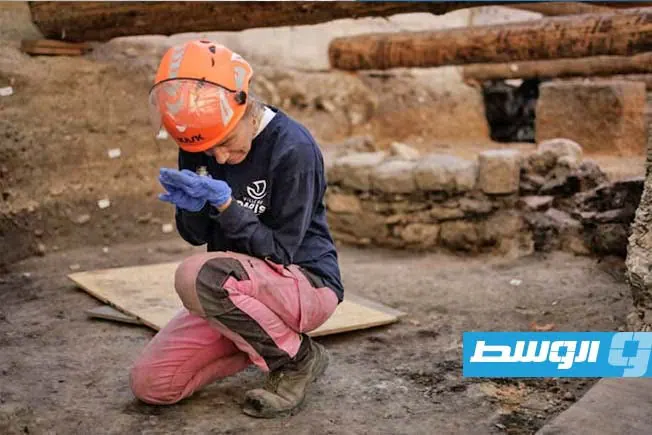
French authorities have made a significant archaeological discovery in the heart of Paris, uncovering a ancient wall that dates back to the Gallic-Roman era. The wall, measuring approximately 20 meters in length, was discovered under a hospital in the Île de la Cité, a historic island in the Seine River. According to the French Ministry of Culture, the wall is believed to be part of the fortifications of Lutetia, the ancient city that predates modern-day Paris.
The discovery has been hailed as a major breakthrough in understanding the origins of Paris. The wall is thought to have been built by the Gallic tribe, who inhabited the area before the Roman conquest. The Ministry of Culture stated that the find could help resolve a long-standing debate about the location of Lutetia, with some researchers suggesting that it may have been located in the western suburb of Nanterre rather than on the Île de la Cité.
The wall, constructed from stone and wood, is believed to have been built during the 1st century BC. Archaeologists have found evidence of fires on the wall, which may support the account of Julius Caesar that the Gauls set fire to their city before the Battle of Lutetia against the Romans. The discovery was made using carbon dating, which suggests that the wall dates back to between 10 and 200 BC.
The French Minister of Culture, Catherine Bergé, described the discovery as a significant achievement, stating that it could provide valuable insights into the history of Lutetia. The minister noted that while further research is needed to confirm the wall's function and chronology, the find is a major step forward in understanding the city's origins.
The Île de la Cité, where the wall was discovered, is a historically significant location, being the site of the famous Notre-Dame Cathedral. The island has been a hub of human activity for centuries, and the discovery of the ancient wall provides a unique glimpse into the city's rich history. According to Paris Mayor Emmanuel Grégoire, the find is a remarkable discovery that sheds new light on the city's past.
Archaeologists are excited about the discovery, as it provides a rare opportunity to study the remains of ancient Lutetia. The wall is one of the most significant archaeological finds in Paris in recent years, and researchers are eager to learn more about its significance. The discovery is also expected to generate interest among historians and archaeologists, who will be able to study the wall and its context in more detail.
The discovery of the ancient wall is a significant addition to the city's cultural heritage, and it is expected to attract visitors and researchers interested in the history of Paris. The French Ministry of Culture has announced plans to preserve and study the wall further, which will provide a unique opportunity for the public to learn more about the city's fascinating history.
Key points
- The discovery of the ancient wall provides new insights into the origins of Paris and the history of Lutetia.
- The wall, dating back to the Gallic-Roman era, is believed to be part of the fortifications of ancient Lutetia.
- The find is expected to generate interest among historians and archaeologists, who will be able to study the wall and its context in more detail.