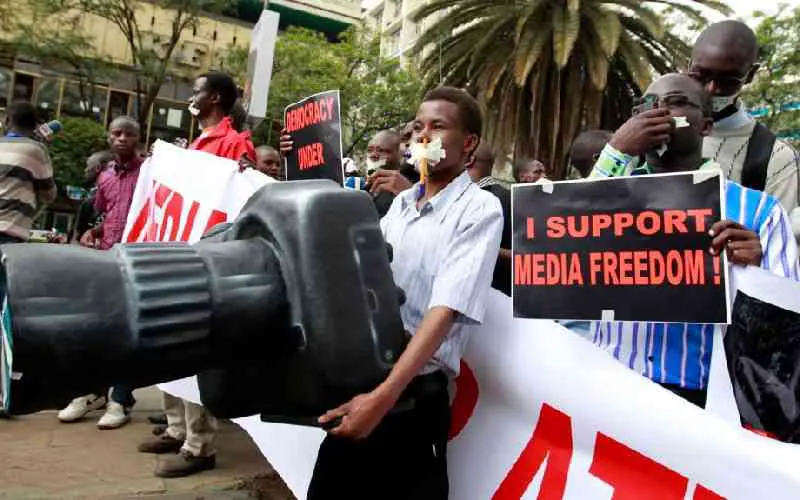
The role of a free press in a democratic society is under threat from censorship and fragmentation. A recent reflection on the author's father's diaries from the 1960s highlights the challenges faced by journalists in a censored environment. The Soviet Union's controlled media landscape was characterized by a scarcity of information, with only one official story allowed. In contrast, today's digital age is marked by an excess of information, with algorithms and social media platforms filtering and ranking content.
The changing landscape of authoritarianism has significant implications for press freedom. The traditional notion of authoritarianism as a geographically bounded phenomenon has given way to a more complex and nuanced reality. The digital partitions that exist today, often within neighborhoods and families, create an environment in which authoritarian movements can exploit weaknesses in the shared reality. This fragmentation is fueled by the influence of powerful technology companies, which shape what we see and how we understand the world.
The consequences of this fragmentation are far-reaching. The abundance of information can make it difficult for individuals to discern what is true and what is not. In this environment, conspiracy theories can thrive, offering simplistic explanations for complex issues. Journalism has the power to build a coherent picture of the world, but this requires time and resources. The 24-hour news cycle can trap newsrooms in a cycle of updates and fragments, making it challenging to produce in-depth reporting.
The issue is not a lack of good reporting, but rather a shortage of journalism that connects the dots. Many newsrooms cover stories in isolation, without considering the broader context or connections between them. Rebuilding local news has become a central democratic project in the United States, but this effort must go beyond simply illuminating individual stories. It requires a more comprehensive approach that draws the map, rather than just highlighting individual dots.
The challenges facing journalism are not limited to any one country. In India and Turkey, journalists face pressure to avoid reporting on certain topics or to follow stories upward into the systems that produce them. In the United States, institutions with the reach to connect the dots are under growing political and regulatory pressure. The recent lawsuit filed by Disney against the FCC highlights the tensions between media companies and regulatory bodies.
The role of technology companies in shaping the media landscape is a critical issue. A handful of powerful men in Silicon Valley have significant influence over what we see and how we understand the world. This concentration of power raises important questions about the impact of technology on democracy and the free press. As the media landscape continues to evolve, it is essential to consider the implications of these changes for the role of journalism in society.
Ultimately, the free press needs alliances to counter the threats of censorship and fragmentation. This requires a renewed focus on the importance of journalism in a democratic society. By recognizing the challenges facing the free press and working together to address them, it is possible to build a more robust and resilient media landscape that serves the needs of citizens.
Key points
- The free press faces challenges from censorship and fragmentation in the digital age.
- The changing landscape of authoritarianism has significant implications for press freedom.
- Journalism needs alliances to counter the threats of censorship and fragmentation.