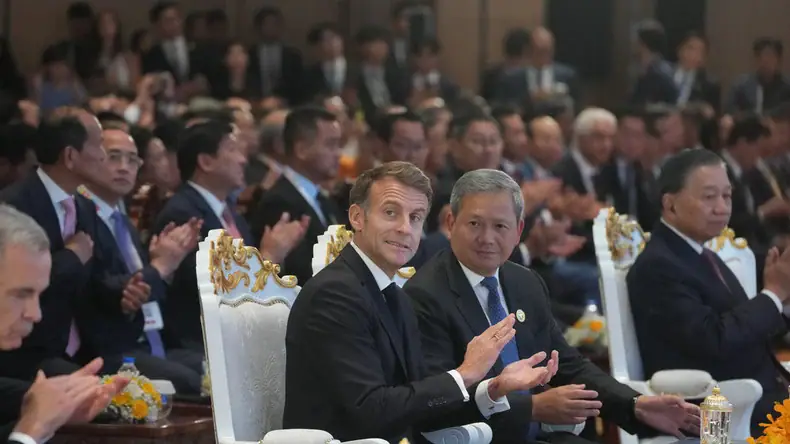
The Francophonie summit held in Phnom Penh, Cambodia, has failed to elect a new secretary-general due to a lack of consensus among member states. As a result, the current secretary-general, Louise Mushikiwabo of Rwanda, will remain in her position for another year. This decision was made after several sources close to the matter reported that the election had been postponed for 12 months. The summit was marked by tensions between Paris and several African delegations.
French President Emmanuel Macron had been pushing for the election of Dacian Ciolos, the former Prime Minister of Romania, as the next secretary-general. However, this move was met with strong opposition from several African delegations, who accused Macron of interfering in the selection process. Macron had written to Rwandan President Paul Kagame, asking him to withdraw Mushikiwabo's candidacy, but Kagame refused. The Rwandan Foreign Minister, Olivier Nduhungirehe, stated that his country would not back down.
The opposition to Macron's initiative was led by several African countries, including Djibouti, Côte d'Ivoire, Gabon, and Cameroon. These countries argued that the selection process should follow the statutory voting procedure. The representative of Djibouti, Abdoulkader Houssein Omar, emphasized that respecting the organization's texts was essential to maintaining its unity. African countries represent 27 of the 53 full members of the Organisation internationale de la Francophonie (OIF), giving them significant influence in the election.
The Democratic Republic of Congo (DRC) initially supported Macron's initiative, announcing the withdrawal of its candidate, Juliana Amato Lumumba. This decision was made amid tensions between Kinshasa and Kigali, with DRC President Félix Tshisekedi threatening to withdraw his country from the OIF if Mushikiwabo was re-elected. However, with the postponement of the election, the DRC's position remains uncertain.
The tensions between Paris and Kigali reached a peak on the final day of the summit. Kagame directly criticized Macron, accusing him of being a "factor of division" due to his "personal agendas" and "interests". Despite efforts by the French presidency to promote a tripartite consultation between the DRC, Rwanda, and Mauritania, no agreement was reached.
The postponement of the election has been seen as a diplomatic setback for Emmanuel Macron. The current secretary-general, Louise Mushikiwabo, is expected to step down after her extended term, and several candidates, including former Mauritanian Minister Koumba Ba, remain in the running. The OIF has confirmed that the candidatures already declared remain in contention, and new candidates can still submit their applications.
The outcome of the summit has been met with mixed reactions. Macron welcomed the compromise, while Kinshasa expressed satisfaction that its voice had been heard. However, Dacian Ciolos, the Romanian candidate, described the day as "very sad" for the Francophonie, warning that the episode could have long-lasting consequences.
Key points
- Current secretary-general Louise Mushikiwabo will remain in her position for another year.
- The election postponement is seen as a diplomatic setback for French President Emmanuel Macron.
- Several candidates, including Koumba Ba, remain in contention for the secretary-general position.
Reporting sources
- Sommet de la Francophonie : faute de consensus, l’élection du secrétaire général de l’OIF reportée d’un an · Le Quotidien de Nouakchott