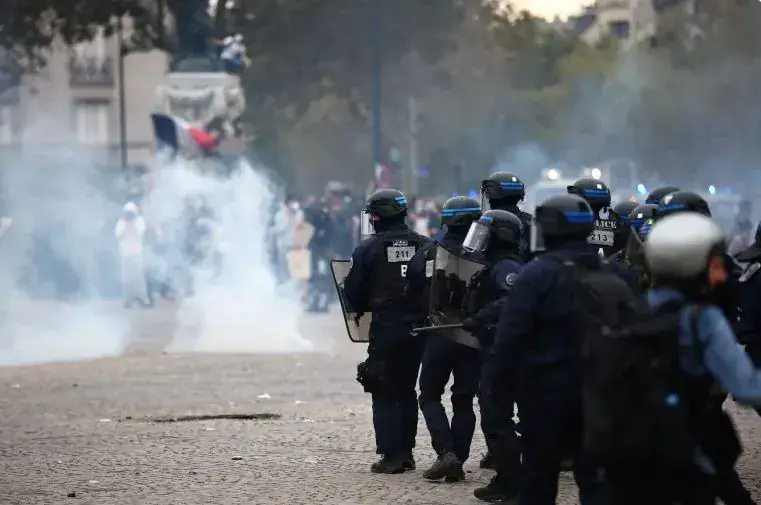
Renewed protests swept across France on Saturday, October 31, 2026, as thousands took to the streets to express their discontent over rising living costs and deteriorating public services. The demonstrations, which began in the afternoon, were largely peaceful, but clashes broke out in Paris and other cities, including Lyon and Toulouse, as night fell. French authorities had been bracing for potential violence, particularly with Halloween celebrations taking place.
The protests, which drew a smaller crowd than in previous weeks, with 320,000 participants nationwide, according to the French Interior Ministry, were driven by a range of grievances, including high fuel prices, inflation, and concerns over the government's policies. The demonstrations brought together students, labor unions, and members of the "yellow vest" movement, which has been critical of the government. Jean-Luc Mélenchon, leader of the far-left La France Insoumise party, was among those who participated in the Paris march.
The French authorities took extensive security measures, including checks at train stations and on roads, to prevent potential violence. The Interior Ministry reported that extremist elements had attempted to break away from the main protests, with the aim of causing destruction and looting. Police were deployed to disperse small groups of protesters, using tear gas in some instances. The ministry said that several people were found to be carrying items that could be used as weapons during the security checks.
The protests in France have been mirrored by similar demonstrations in other European countries, including Germany and Italy. In Germany, thousands of people took to the streets in several cities, while in Italy, protests were reported in Rome and other major cities. The wave of protests reflects growing concerns over the cost of living and economic uncertainty across the continent.
The French government, led by President Emmanuel Macron, has faced criticism for its handling of the economy and public services. The protests have put pressure on the government to address the concerns of citizens, particularly with regard to the cost of living and the quality of public services. The Interior Ministry reported that 70,000 people participated in the Paris protest, a smaller number than in previous weeks.
The protests also highlighted the growing popularity of Jean-Luc Mélenchon, who has seen a surge in support in recent weeks. Mélenchon's party has been critical of the government's economic policies and has called for greater investment in public services. The protests have also drawn attention to the challenges facing the French government as it prepares for the next presidential election.
The French authorities remain on high alert, with concerns over potential further unrest in the coming days. The government has urged calm and warned that it will take firm action against those who engage in violence or destruction. The protests have highlighted the ongoing challenges facing France and other European countries as they navigate economic uncertainty and growing public discontent.
Key points
- The protests drew 320,000 participants nationwide, with 70,000 in Paris.
- The demonstrations were driven by concerns over rising living costs, high fuel prices, and inflation.
- The protests have put pressure on the French government to address citizen concerns over the economy and public services.