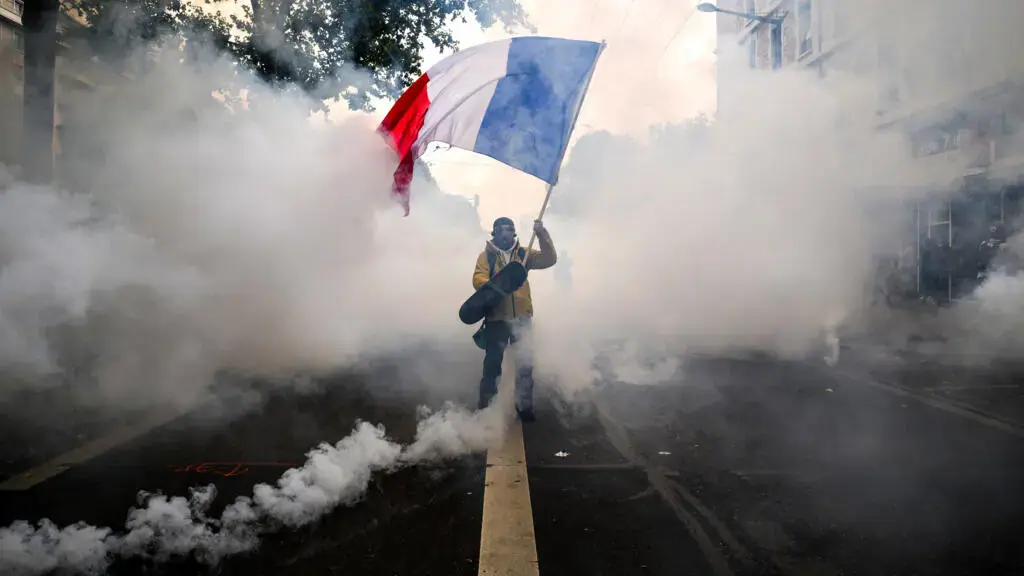
French authorities deployed 70,000 police officers and gendarmes across the country on Saturday as students, workers, unions, and yellow vests protesters took to the streets for the fourth consecutive weekend to demand better living conditions and oppose rising living costs. The Interior Ministry reported around 7,000 participants across 68 public actions nationwide, marking a decline in turnout compared to previous demonstrations.
The Paris police prefecture reported around 46,000 people joining the demonstration in the capital, mostly young people, including high school and university students, as well as workers and trade union representatives. They marched from Place de la République toward Place de la Nation. This marked a decline from Thursday, when authorities counted 65,000 demonstrators in Paris, and 575,000 people across 193 public actions nationwide.
The General Confederation of Labour (CGT) estimated that 1.6 million people took part in Thursday's demonstrations. Saturday's march in Paris began peacefully but tensions later escalated near Place de la Nation, where police fired tear gas and grenades after a group of around 200 people allegedly attacked officers and threw projectiles and homemade fireworks. Several police officers and gendarmes sustained injuries.
Authorities reported 18 arrests on Saturday, compared to 27 at the same time the previous Saturday, and more than 15,600 preventive identity checks. Nationwide, 232 arrests were reported. No injuries among demonstrators had been confirmed in official reports at the time of publication.
The government had announced an extensive security operation ahead of Saturday's demonstrations, including 110 mobile security units, armored vehicles, water cannons, helicopters, and drones. Authorities also introduced restrictions on demonstrations in several city centers, including a ban on gatherings in Rennes' city center following violence during Thursday's protests.
The latest mobilization comes ahead of a meeting between Prime Minister Sébastien Lecornu, trade unions, and employers' organizations scheduled for Monday, which will address wages and purchasing power. Student and education organizations have also called for another national strike on Tuesday, November 10, demanding increased funding for education.
The demonstrations began in late September with high school students protesting conditions in their schools before expanding into a broader movement involving students, workers, and trade unions.
Key points
- Authorities counted around 7,000 participants across 68 public actions nationwide.
- The Interior Ministry reported 18 arrests, compared to 27 at the same time the previous Saturday.
- The government deployed 70,000 police officers and gendarmes across France for the protests.