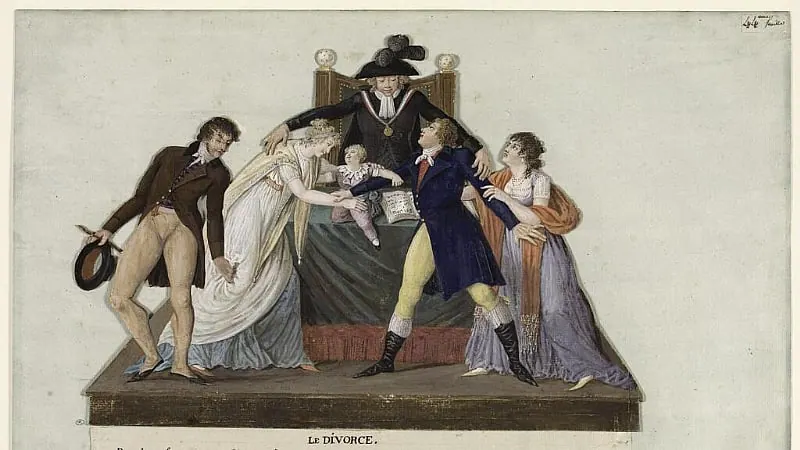
France's first divorce law, enacted on September 20, 1792, marked a significant turning point in the country's social history. The law, which was part of the French Revolution's efforts to overhaul centuries-old customs, allowed couples to divorce by mutual consent or for reasons such as absence, abuse, or incompatibility. This was a radical departure from the previous system, which only allowed separation and not remarriage. The new law also introduced a more accessible and discreet procedure for filing for divorce.
The 1792 divorce law was a liberal reform that reflected the Revolution's emphasis on individual freedom. According to historian Roderick Phillips, the law was "very, very liberal" compared to other European countries at the time. The law applied equally to husbands and wives, and couples could divorce by mutual consent or on the basis of "incompatibility". The procedure for filing for divorce was also innovative, involving a family court composed of relatives or friends appointed by the couple.
The introduction of divorce in France was part of a broader project to reform the family and promote equality and fraternity. The law was seen as a way to redress injustices faced by women, who often had limited options for ending unhappy marriages. In fact, most divorces in France were initiated by women, with over 76% of petitions for divorce filed by women in the city of Rouen. The law also reflected the Revolution's emphasis on individual freedom and equality.
The initial impact of the law was significant, with around 38,000 to 50,000 divorces taking place in France in the 11 years after its passage. However, the rate of divorce peaked soon after its introduction and then leveled off. According to historian Suzanne Desan, the law was initially catching up to the facts, with many couples formalizing de facto break-ups. Couples who opted for no-fault divorces were usually the simplest to claim.
The divorce law was also influenced by the Revolution's emphasis on making household disputes a matter for families, not lawyers, to resolve. The procedure for filing for divorce involved a family court composed of relatives or friends appointed by the couple, who would try to reconcile the partners or hear evidence. This approach was in contrast to England, where the only way to obtain a divorce was to persuade parliament to pass a private act.
Despite its liberal nature, the 1792 divorce law was not without its critics. Conservatives warned that the reform would unravel the fabric of society, and the law was eventually restricted under Napoleon in 1804. The monarchy's restoration in 1816 led to the abolition of divorce, which was not reinstated until 1884. However, the legacy of the 1792 divorce law continued to shape French society and influence future reforms.
The 1792 divorce law remains an important milestone in the history of family law and social reform in France. According to Phillips, the law reflected the Revolution's emphasis on individual freedom and equality, and its impact was felt for generations to come. The law's influence can be seen in modern France's more liberal divorce laws, which were introduced in 1975.
Key points
- France's 1792 divorce law was a groundbreaking social revolution that allowed couples to divorce by mutual consent or for reasons such as absence, abuse, or incompatibility.
- The law was part of a broader project to reform the family and promote equality and fraternity, and its impact was felt for generations to come.
- The legacy of the 1792 divorce law continues to shape French society and influence future reforms.