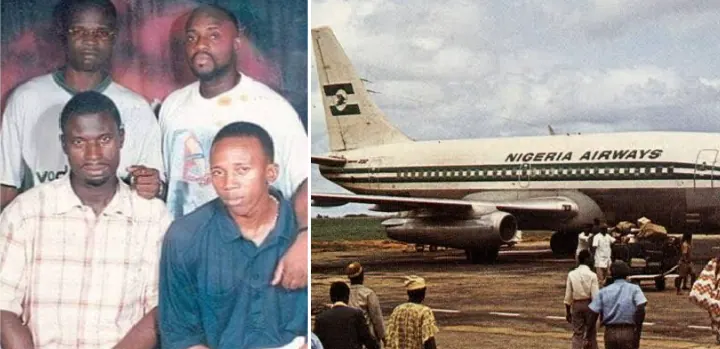
On October 25, 1993, four young Nigerians seized control of Nigeria Airways Flight WT470 during its routine journey from Lagos to Abuja, turning the flight into an international crisis. Richard Ajibola Ogunderu, then just 19, along with Kabir Adenuga, Kenny Rasaq Lawal, and Benneth Oluwadaisi, boarded the Airbus A310, named Rima River, at Murtala Muhammed Airport. Their objective was clear: use the aircraft as a dramatic stage to force global attention onto Nigeria’s deepening political turmoil.
Nigeria in 1993 was a nation gripped by political uncertainty, reeling from the annulment of the June 12 presidential election. Moshood Abiola was widely believed to have won that election, but the military regime under General Ibrahim Babangida nullified the results, plunging the country into a crisis. Babangida eventually stepped down in August, yielding to an Interim National Government led by Ernest Shonekan. Yet, this transition offered little stability; military influence remained pervasive, and public discontent simmered, particularly among younger Nigerians who felt disenfranchised.
The hijackers saw an extreme act as their only recourse to amplify their voices. They believed ordinary political pressure was failing, so they opted for a highly visible stunt designed to capture international headlines and highlight the injustice of the annulled election and other national grievances. Their destination was not Abuja, but Frankfurt, Germany, a symbol of European democracy and media attention. The hijackers’ plan hinged on a calculated psychological advantage rather than brute force.
The hijackers boarded Flight WT470 with an array of items: lighters, tear gas, jackknives, and what Richard Ogunderu later described as toy guns. These imitation firearms served to establish immediate control, creating the impression of armed authority among unsuspecting passengers and crew. However, the actual power of their threat resided in the containers of petrol they had smuggled onto the aircraft. This stark contrast between a reportedly fake weapon and a very real, common substance formed the crux of their strategy.
The consequence of the hijacking was a terrifying standoff. The hijackers' primary leverage—the threat of immolating the aircraft—ensured that their demands had to be taken seriously. Authorities were not merely negotiating for the escape of four individuals; they were working to prevent the destruction of a passenger jet and the loss of all on board. Paradoxically, the hijackers soon faced their own fuel problem. Flight WT470, a domestic route, lacked the aviation fuel necessary to reach Frankfurt.
This forced them to seek a refuelling stop, leading the aircraft to land at Diori Hamani International Airport in Niamey, Niger. This unexpected diversion profoundly altered the dynamics of the crisis. Once on the ground in Niamey, the hijackers’ mobility vanished. The aircraft was now stationary, surrounded by Nigerien authorities who had time to strategize and prepare a response. This change in location allowed for negotiations to commence, and many passengers, including Chinese Vice President Rong Yiren, were gradually released.
The standoff lasted approximately four days. On 28 October 1993, Nigerien security forces moved in, storming the aircraft. The operation ended the hijacking, with the four men captured, though Ogunderu sustained injuries. Tragically, assistant purser Ethelbert Nwanze Igwe was killed during the rescue operation, a grim reminder of the real human cost.
Key points
- The hijacking was a dramatic act of protest against Nigeria's political turmoil.
- The hijackers used petrol as a threat to control the aircraft and its passengers.
- The incident highlighted significant security failures at Nigerian airports.