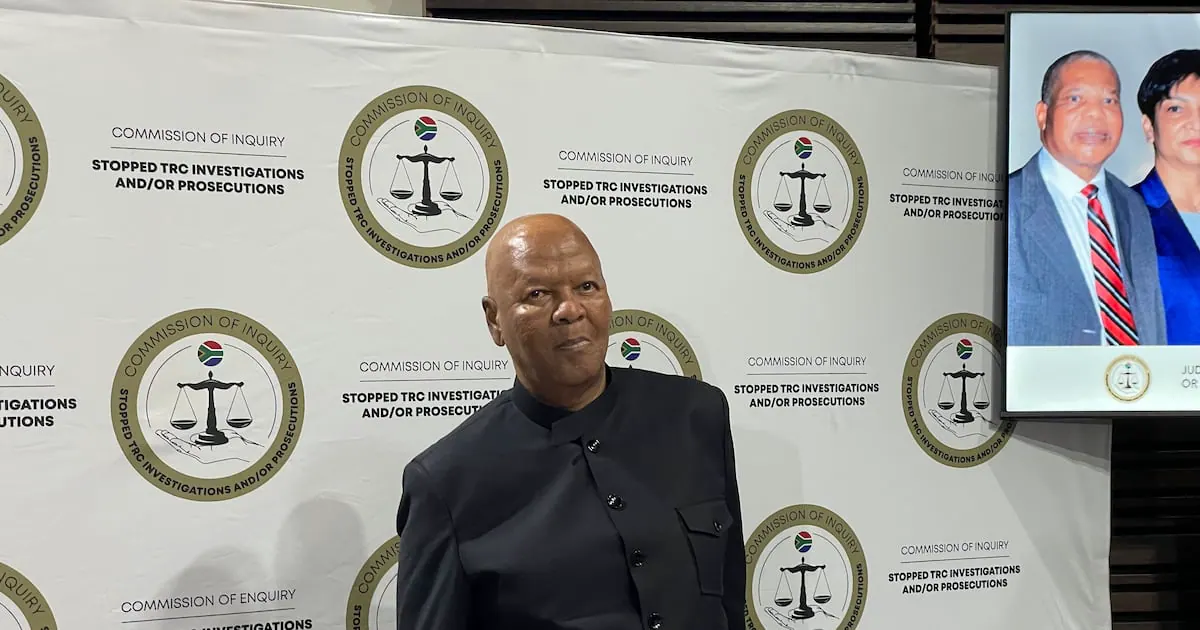
Former South African justice minister Jeff Radebe has testified at the Khampepe commission of inquiry into the Truth and Reconciliation Commission (TRC) cases. During a heated cross-examination, Radebe stated that the government's attitude towards apartheid-era perpetrators who did not submit themselves to the TRC was that they were supposed to be prosecuted. However, some perpetrators remain free. Radebe's testimony was sought by advocate Howard Varney, who represents the Calata group, who lost family members during apartheid.
Radebe, who served as justice minister from 2009 to 2014, clarified that he was not the responsible minister at the time and therefore could not recall specific details about the government's approach to TRC cases. He noted that he was one of the coordinating ministers of the economic cluster and not focused on justice clusters. Radebe acknowledged being aware of an amnesty task team established in 2004, but said he could not provide details about its dynamics or initiatives.
The amnesty task team was appointed in February 2004 to evaluate whether the National Prosecuting Authority should prosecute past conflict cases, introduce further amnesty, or make legislative changes. Varney suggested that the process amounted to an attempt to give perpetrators additional opportunities to avoid prosecution after the TRC's amnesty process. However, Radebe rejected the suggestion, stating that he was not the appropriate person to answer for the decisions.
Radebe pointed to his own experience of the TRC amnesty process, having received amnesty for crimes committed during apartheid. He emphasized that the TRC process was conceptualized to allow people to come forward and tell the truth in exchange for amnesty. Radebe's testimony highlighted the complexities of the TRC process and the challenges of seeking justice for apartheid-era crimes.
Varney distinguished between the original TRC amnesty process and the later measures being examined by the inquiry. He argued that the attempts to introduce further measures were endeavors to assist perpetrators to escape justice post-TRC's amnesty process. Radebe maintained that he could not take the argument further, repeating that he had already stated his position.
Radebe referred to a 2003 parliamentary statement by the president, outlining the government's policy attitude towards apartheid-era perpetrators who did not submit to the TRC process. The president stated that such perpetrators must be prosecuted. Radebe emphasized that this reflected the government's attitude at the time, which was to pursue justice for those who did not submit to the TRC.
Radebe conceded that the families of victims killed during the apartheid era have the right to justice and may be entitled to some form of compensation. His testimony at the Khampepe commission of inquiry highlights the ongoing challenges of addressing apartheid-era crimes and providing justice to victims and their families. The inquiry continues to examine the TRC cases and the government's response to them.
Key points
- The government's attitude towards apartheid-era perpetrators who did not submit to the TRC was that they were supposed to be prosecuted.
- Former justice minister Jeff Radebe testified at the Khampepe commission of inquiry into TRC cases.
- The TRC process was conceptualized to allow people to come forward and tell the truth in exchange for amnesty.