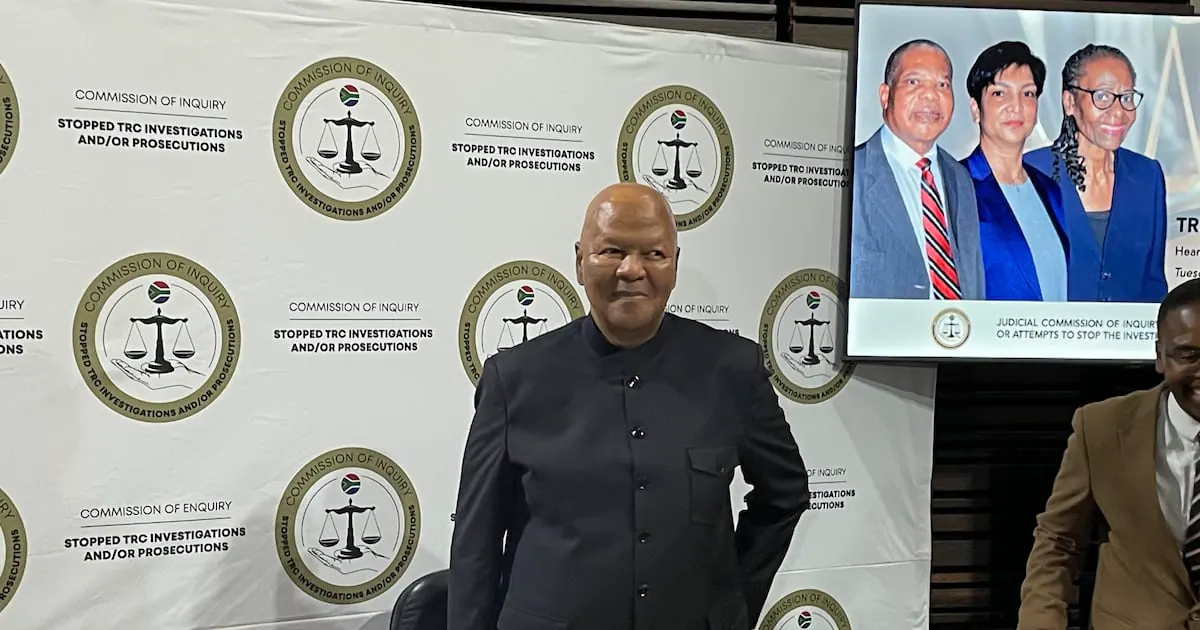
Former justice minister Jeff Radebe was questioned by Adv Howard Varney at the Khampepe commission, which is investigating the delay in the investigation and prosecution of Truth and Reconciliation Commission (TRC) cases. Radebe was presented with a paper trail showing that serious problems surrounding the investigation and prosecution of apartheid-era crimes had been brought to his attention while he was in office. The commission is examining the reasons behind the stalled prosecutions of apartheid-era crimes.
Varney presented Radebe with a May 2009 memorandum from the then acting national director of public prosecutions, Mokotedi Mpshe, which highlighted problems with TRC-related matters. The memo stated that the Pepco 3 case, involving the 1985 abduction and murder of three anti-apartheid civic leaders, was a prime example of a “general problem with all TRC-related matters”. The case involves the murder of Sipho Charles Hashe, Qaqawuli Godolozi, and Twasile Champion Galela, prominent leaders of the Port Elizabeth Black Civic Organisation.
Radebe claimed he was unaware of the systemic obstacles affecting TRC cases, citing his newness to the department at the time. He stated that he was still understanding the activities of the department and that investigation of crimes in South Africa is the responsibility of the South African Police Service. Varney pressed Radebe on whether he should have contacted the police minister after receiving the warning, but Radebe replied that the benefit of hindsight is a perfect science.
The inquiry also examined a 2013 memorandum from the then acting national director of public prosecutions Shaun Abrahams, detailing further problems with outstanding TRC investigations and prosecutions. The memorandum, signed by Radebe, recommended that the matter be brought to the cabinet. Radebe agreed that the issues relating to the TRC cases were brought to his attention in this memorandum.
Radebe was also questioned about the Nokuthula Simelane case, acknowledging that an August 2013 memorandum and correspondence from the Legal Resources Centre had brought the matter to his attention. Simelane, the sister of human settlements minister Thembi Nkadimeng, disappeared during apartheid. Varney later asked whether Radebe would accept some responsibility for the failure to deliver on TRC cases during his tenure.
Radebe replied that he thought responsibility should be apportioned to the appropriate authorities, adding that “the minister of justice is not responsible for prosecuting”. The inquiry was stood down until September 28. The commission’s findings could have significant implications for the investigation and prosecution of apartheid-era crimes.
The proceedings also involved an exchange between Varney and the inquiry’s chairperson, justice Sisi Khampepe, over the omission of pages from the 2009 memo. Varney suggested that the omission was “probably not coincidental”, but Khampepe directed him to provisionally withdraw the assertion, citing a lack of evidence.
Key points
- Former justice minister Jeff Radebe was confronted with a paper trail showing that serious problems surrounding the investigation and prosecution of apartheid-era crimes had been brought to his attention while he was in office.
- Radebe claimed he was unaware of systemic obstacles affecting TRC cases, citing his newness to the department at the time.
- The inquiry was stood down until September 28, with the commission’s findings potentially having significant implications for the investigation and prosecution of apartheid-era crimes.