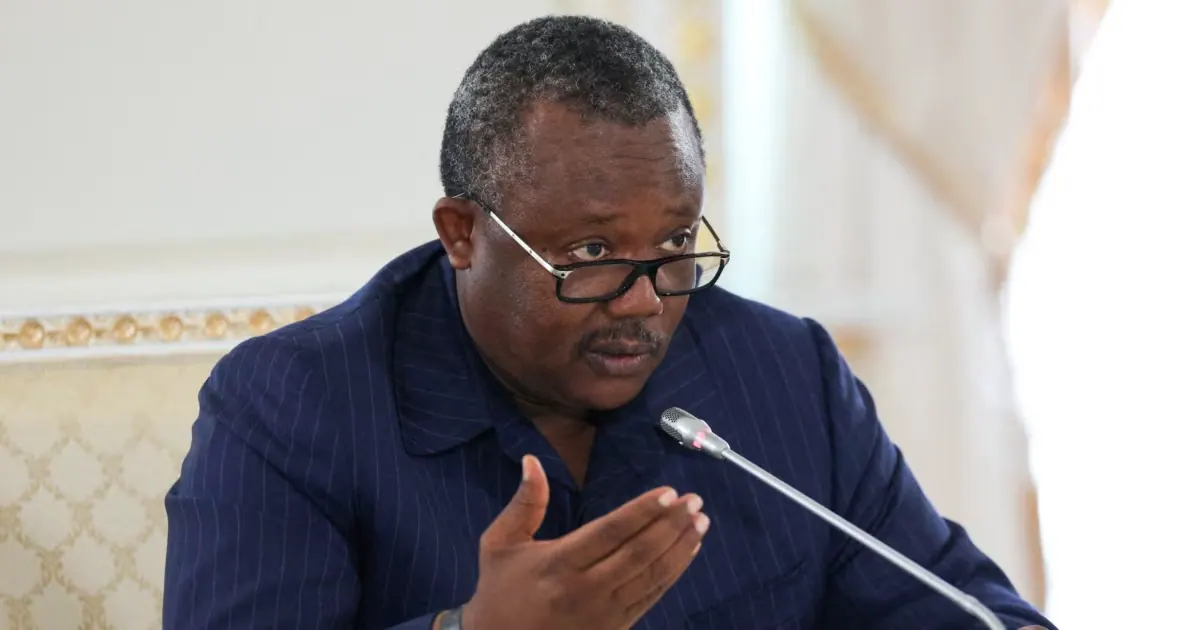
Former Guinea-Bissau President Umaro Sissoco Embaló has announced his candidacy for the presidential election on December 6, 2026. Embaló, who was ousted in a military coup in November 2025, confirmed his intention to run in the election under the banner of the Republican Platform. He made the announcement in an interview with Jeune Afrique magazine published on September 28, 2026. Embaló's return to Guinea-Bissau is set for October 4, 2026, two months before the presidential election.
Embaló was overthrown by the military on November 26, 2025, just hours before the announcement of the presidential election results. He was arrested in his office at the presidential palace. Following the coup, General Horta N'Tam was invested as the president of the transition and head of the High Military Command for the restoration of national security and public order. The Economic Community of West African States (ECOWAS) suspended Guinea-Bissau from its decision-making bodies and demanded the restoration of constitutional order.
Since the coup, the transitional authorities have undertaken a deep institutional reform. On August 30, 2026, Guinean-Bissau citizens were called to vote in a referendum on a new constitution adopted by the National Transitional Council. The National Elections Commission (CNE) announced on September 1, 2026, that the "yes" vote had won with 383,117 votes, or 70% of valid votes, against 160,904 votes for the "no". A total of 572,714 voters participated in the ballot out of 914,428 registered.
The new constitution strengthens the powers of the President of the Republic in the exercise of executive power and redefines the roles of the Prime Minister and Parliament. Guinea-Bissau is heading towards the general elections on December 6, 2026, in a profoundly changed institutional framework. ECOWAS has taken note of the calendar and called on the transitional authorities to guarantee a transparent and inclusive process.
The Senegalese country has been designated as facilitator of the dialogue between the different Bissau-Guinean parties. The return of Umaro Sissoco Embaló adds a new element to the presidential election organized after a major institutional rupture. Embaló's candidacy comes as the country is preparing for the polls under a new constitution and a transitional government.
ECOWAS had engaged in mediation, involving Senegal, to help restore constitutional order in Guinea-Bissau. The regional organization had also suspended Guinea-Bissau from its decision-making bodies following the coup. The December 6 presidential election will be a crucial test for the country's stability and democratic progress.
Embaló's return to politics is seen as a significant development in the lead-up to the presidential election. His candidacy under the Republican Platform is expected to add a new dynamic to the electoral process. The election outcome will be closely watched by ECOWAS and other international observers.
Key points
- Former Guinea-Bissau President Umaro Sissoco Embaló announces candidacy for December 6 presidential election
- Guinea-Bissau adopts new constitution ahead of presidential election
- ECOWAS calls for transparent and inclusive electoral process in Guinea-Bissau