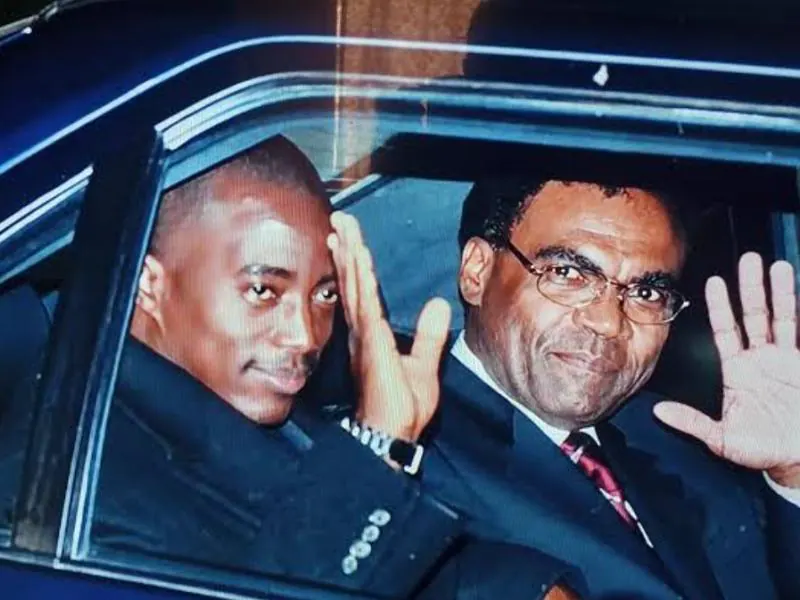
In January 2001, Laurent-Désiré Kabila's assassination plunged the Democratic Republic of Congo into uncertainty. Léonard She Okitundu, who would become the country's Foreign Minister under Joseph Kabila, was in Yaoundé at the time. He was faced with a choice: return to a country in turmoil or go into exile. Okitundu decided to return to Kinshasa after a personal call from Joseph Kabila, who asked him to come back as soon as possible.
Okitundu's reappointment as Foreign Minister was not coincidental. Augustin Katumba Mwanke, who was tasked with forming a new government, had conducted a survey among several personalities to find the right person for the job. According to Okitundu, Katumba Mwanke told him that all the personalities consulted had recommended him for the position. The challenge was immense, with the country facing diplomatic isolation due to human rights issues and non-compliance with certain commitments to the World Bank and IMF.
The situation of human rights was a top priority for reassuring international partners. The Congolese diplomacy chose to start with Scandinavian countries, considered models in human rights, particularly Sweden, with which the DRC had a long history of cooperation. The goal was to convince them that the new government would engage in reforms that respected fundamental rights. This was followed by visits to Paris, London, and Washington, where Okitundu and Kabila met with Jacques Chirac, Tony Blair, and George W. Bush, respectively.
A key moment in this diplomatic effort was Joseph Kabila's visit to the UN Human Rights Commission in Geneva, where he announced a moratorium on the death penalty. This move was well-received and helped ease tensions with Western partners. Okitundu emphasized that Kabila's youth, at 29, did not hinder his diplomatic interactions. Despite being accompanied by advisors, Kabila met with his counterparts alone, and Okitundu reported no issues with his performance.
The meeting with French President Jacques Chirac was particularly significant. Chirac had previously supported Laurent-Désiré Kabila and had invited him to Yaoundé. Okitundu highlighted the crucial role France played as a "hinge force" within the UN Security Council, providing considerable support to the DRC on the international stage. This relationship was vital in helping the country navigate its diplomatic isolation.
Okitundu's account provides insight into the early diplomatic efforts of Joseph Kabila's presidency. The country's international isolation was a pressing issue, and Okitundu's reappointment as Foreign Minister was a strategic move to address this challenge. The diplomatic tour, which included visits to Scandinavian countries, France, the UK, and the US, was a crucial step in reassuring international partners of Kabila's commitment to reform.
The efforts of Okitundu and Kabila ultimately contributed to improved relations with Western partners. The moratorium on the death penalty, announced by Kabila in Geneva, was a significant gesture that helped ease tensions. Okitundu's reflections on Kabila's diplomatic performance, particularly at a young age, suggest that the president was able to navigate complex international interactions effectively.
Key points
- Joseph Kabila's government prioritized human rights reforms to overcome international isolation.