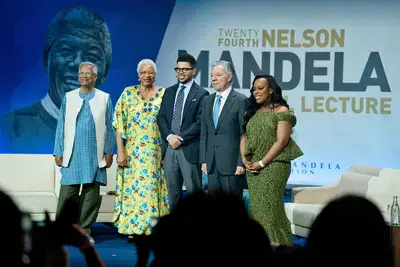
Former Colombian president Juan Manuel Santos has urged South Africa to defend its values and principles in global relations, warning that silence in the face of injustice is complicity. In his address at the 24th Nelson Mandela Annual Lecture in Cape Town, Santos emphasized that economic interests cannot be the only consideration in relations between countries. He argued that nations must prioritize human dignity and uphold international law.
Santos, the 2016 Nobel Peace Prize laureate and chair of The Elders, delivered the lecture at the Cape Town International Convention Centre on 6 November. The Nelson Mandela Foundation hosted the event in partnership with One Young World, whose summit brought young leaders from around the world to the city. Santos's message was clear: governments that fail to oppose injustice because doing so is politically inconvenient or economically costly help create a world governed by force.
In an interview with the Mail & Guardian following the lecture, Santos applied his message to relations between countries, including South Africa's dealings with the United States. He urged countries to persuade the more powerful party that short-term thinking would ultimately harm everyone's interests. Santos advised South Africa to defend its principles and values, saying this was essential for every nation or person.
Santos's argument allows for the discretion that negotiation requires, recognizing that silence can create room to listen, while words spoken prematurely or in anger can close doors. He paid tribute to South African jurist Navi Pillay, whose work defending human rights demonstrated why peace depended on the strength of law rather than the will of the strongest. Santos's own understanding of this responsibility was influenced by a conversation with Nelson Mandela in 1996.
The conversation with Mandela stayed with Santos through Colombia's war and negotiations with the Revolutionary Armed Forces of Colombia (FARC). By 2010, when he became president, Santos had built his reputation through military operations against the FARC. Choosing negotiations meant confronting expectations that he would continue the war, and his family warned against talks. Previous efforts had failed, and he risked being branded a traitor.
Santos's negotiations with the FARC continued while fighting went on, with every attack bringing renewed pressure to abandon the table. He said he had refused to let violence determine whether Colombia could have a different future. Listening to victims helped sustain him, and their accounts reminded him what was at stake when negotiations became exhausting or politically isolating.
A decade after Colombia's peace agreement, Santos said many of its commitments remained unfulfilled, with communities still awaiting the benefits of peace. He attributed shortcomings in implementation to the two administrations that succeeded his, and rejected claims that the agreement itself was responsible. Santos emphasized that its implementation remained essential for lasting peace.
Key points
- Santos urges South Africa to prioritize values over economic interests in global relations.
- He warns that silence in the face of injustice is complicity.
- Santos emphasizes the importance of upholding international law and human dignity.
Reporting sources
- Santos to South Africa: Defend your principles · Mail & Guardian