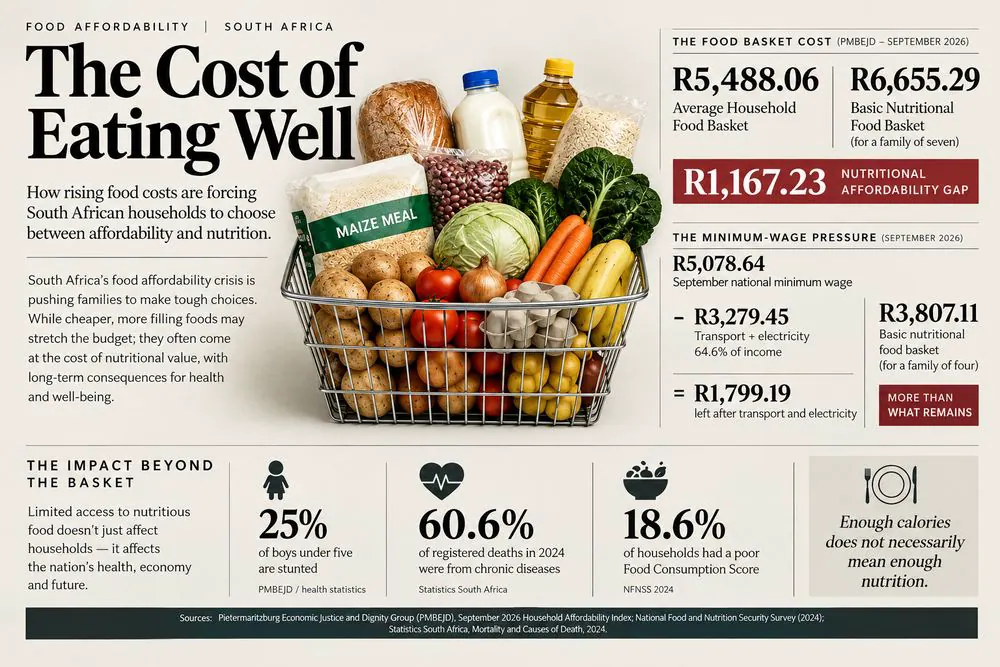
A recent report by the Pietermaritzburg Economic Justice and Dignity Group (PMBEJD) has highlighted the challenges faced by South African households in accessing affordable and nutritious food. The September Household Affordability Index revealed that the average Household Food Basket cost R5 488.06, while the Basic Nutritional Food Basket for a family of seven cost R6 655.29, a difference of R1 167.23. This gap has significant implications for households under financial pressure, who are forced to make difficult choices between the cost of food and its nutritional value.
According to Mervyn Abrahams of PMBEJD, the impact of rising living costs is evident in the choices households make at the point of purchase. Households are buying less food, and less quality food, and becoming more discerning in their purchasing decisions. This is a result of the significant pressure on household budgets, with transport and electricity accounting for 64.6% of the September national minimum wage of R5 078.64, leaving less than half for other essentials, including food. As a result, households are opting for cheaper, more filling products, even if they offer less dietary variety.
The consequences of households not being able to afford sufficient, nutritious food are evident in South Africa's health statistics. The country has a high stunting rate, with 25% of boys under the age of five being stunted, a direct result of not receiving enough protein. Additionally, South Africa has high rates of diabetes, hypertension, and other non-communicable diseases, which are directly linked to a lack of nutritious food. Abrahams noted that the impact of food insecurity extends beyond individual health, with significant implications for the economy as a whole.
Dr Heinrich Volmink, chief operating officer of Physicians Association for Nutrition South Africa, emphasized the distinction between consuming enough calories and getting adequate nutrition. While households may prioritize affordable, filling foods, these options often lack sufficient dietary variety, fibre, vitamins, and minerals. Regularly consuming foods high in energy but low in nutritional value can contribute to excessive energy intake and increase the risk of obesity, hypertension, type 2 diabetes, and cardiovascular disease.
The 2024 National Food and Nutrition Security Survey found that 58.1% of households had an acceptable Food Consumption Score, while 23.3% were classified as borderline and 18.6% as poor. Volmink cautioned that a poor Food Consumption Score does not necessarily establish a nutrient deficiency, but limited dietary variety can increase the risk of nutritional inadequacy. Statistics South Africa recorded 474,366 registered deaths in 2024, with chronic diseases accounting for 60.6% of all deaths.
The National Department of Health has identified unhealthy diets as a significant risk factor contributing to South Africa's burden of non-communicable diseases (NCDs). The department's latest mortality data show that NCDs accounted for 60.6% of registered deaths in South Africa in 2024, with diabetes, hypertension, and cerebrovascular diseases being significant contributors. Deputy Health Minister Dr Joe Phaahla emphasized the importance of healthy lifestyles, including a healthy diet, in preventing NCDs.
The food affordability crisis in South Africa has significant implications for households, the economy, and the health sector. With many households unable to afford nutritious food, the country is likely to see a continued rise in NCDs and other health problems. Addressing the root causes of food insecurity and promoting healthy lifestyles will be critical in mitigating the impact of the crisis and ensuring that South African households have access to affordable, nutritious food.
Key points
- South African households are struggling to afford nutritious food, with many opting for cheaper, less nutritious options due to financial pressure.
- The country's high rates of stunting, diabetes, and other non-communicable diseases are directly linked to a lack of nutritious food.
- Addressing the root causes of food insecurity and promoting healthy lifestyles will be critical in mitigating the impact of the crisis and ensuring that South African households have access to affordable, nutritious food.