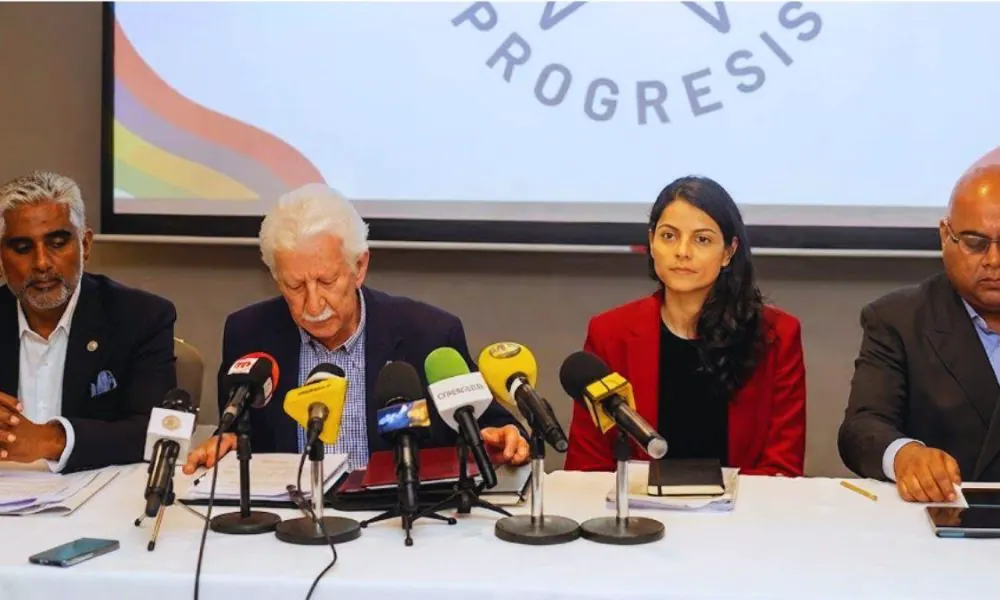
The Fron Militan Progresis (FMP) party in Mauritius has strongly denounced the proposed creation of a National Crime Agency (NCA), describing it as a severe threat to the nation's democratic foundations and institutional balance. During a press conference, FMP leader Paul Bérenger, along with other party members, condemned the proposed legislation and demanded its immediate withdrawal. The party has threatened to take the matter to the Supreme Court and the Privy Council if the government proceeds with the plans.
According to Bérenger, the proposed NCA poses significant constitutional concerns, particularly with regards to the subordination of the police and marginalization of the judiciary. The FMP leader warned that multiple provisions in the proposed legislation violate section 1 of the Constitution, which establishes Mauritius as a sovereign and democratic state. The party has also expressed concerns over the executive control of the new agency, with the Director General being appointed directly by the Prime Minister.
The FMP has highlighted several institutional threats posed by the proposed NCA, including the potential for abuse of power and the undermining of judicial independence. Me Rama Valayden criticized the predominant role given to the interim Director General in setting up nine divisions and designating a permanent successor, alongside a potential cumulative mandate of up to eight years. The party has also warned that inequalities in salary treatment risk sparking deep frustrations within the police force.
Chetan Baboolall drew attention to clause 53 of the proposed legislation, which governs operations of control and surveillance. He expressed alarm over provisions allowing investigative officers to intercept communications and place citizens under surveillance without a judge's warrant. Bérenger reinforced these warnings, labeling the surveillance and espionage provisions as shocking compared to standard police procedures that require the green light of a judge in Chambers.
The FMP has also criticized the proposed NCA's resemblance to a "Mauritian-style" creation that fundamentally undermines judicial independence. Bérenger argued that the British model, which the proposed NCA is based on, is currently being restructured into a National Police Service under a National Police Commissioner. The FMP leader questioned the government's decision to adopt a model that is being phased out in the UK.
While acknowledging the need to replace the Financial Crimes Commission (FCC) and strengthen legal tools against financial crime and cybercrime, the FMP has rejected the government's current formula. Neelkanth Dulloo called for a national debate involving unions, police officers, academics, students, and retirees, while Me Valayden initiated public forums across the island to mobilize the population.
Bérenger issued a final warning to the government, urging them to reconsider the proposed legislation and come up with alternative proposals. If the government persists with the current plans, the FMP is prepared to take the matter to the Supreme Court and, if necessary, the Privy Council. The party's opposition to the proposed NCA has sparked a national debate on the issue, with various stakeholders weighing in on the potential implications of the proposed legislation.
Key points
- The FMP has threatened to take the matter to the Supreme Court and the Privy Council if the government proceeds with the plans to create a National Crime Agency.
- The proposed NCA has sparked concerns over constitutional integrity, institutional balance, and potential for abuse of power.
- The FMP has called for a national debate on the issue and initiated public forums across the island to mobilize the population.