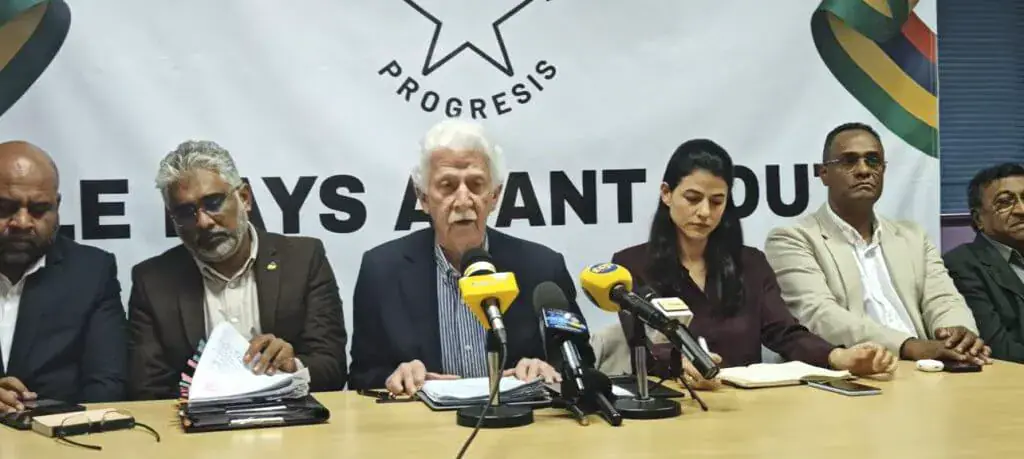
The leader of the Front Militan Progresis (FMP), Paul Bérenger, addressed several pressing issues in Mauritius during a press conference on November 7. He expressed his views on the Chagos dispute, suggesting that Mauritius should draw inspiration from the agreement between the United States and Denmark regarding Greenland. This idea was also recently proposed by Andy Burnham in interviews with The Economist and The Guardian. Bérenger welcomed the fact that UK Prime Minister Rishi Sunak has taken up the suggestion but expressed regret that former Prime Minister Navinchandra Ramgoolam did not consider it earlier.
Bérenger also criticized the absence of Prime Minister Navinchandra Ramgoolam in parliament, citing that there were no parliamentary proceedings on the previous Tuesday and that the PM would be absent again on the upcoming Tuesday. According to Bérenger, the PM's absence is a habitual occurrence, as he often travels abroad, such as to the Peace Forum in Paris, and meets with experts in London. Furthermore, Bérenger expressed concern over the issue of 3,000 missing foreign workers, denouncing Reza Uteem, the Minister of Labour, for stating that the police were unable to convict a single illegal employer.
The FMP leader also criticized the government's handling of the Water Tank and Water Pump Grant Scheme, citing incompetence and a lack of preparedness. He mentioned that the scheme, which was announced earlier, had not been updated to reflect current prices, despite the ongoing water crisis in the country. Bérenger also expressed frustration over the government's decision to engage five experts from Singapore, stating that numerous experts have already been consulted and submitted reports in the past.
Bérenger called for a more efficient and effective approach to addressing the country's problems, including the need for a new Prime Minister, a full-time Finance Minister, and a new Attorney General. He also emphasized the need for a more robust response to the issue of drug trafficking and the role of the police and coast guard in addressing this problem. Additionally, Bérenger criticized the government's handling of the Agricultural Marketing Board (AMB) and the allocation of agricultural land to certain individuals.
Chetan Baboolall, the leader of the opposition, also spoke during the press conference, calling for the arrest of those responsible for financing and inciting recent riots. He also highlighted the poor working conditions faced by foreign workers, citing the recent tragic death of three Bangladeshi nationals in Plaine-des-Papayes. Bérenger and Baboolall both expressed concern over the treatment of foreign workers, describing it as a form of modern-day slavery.
Joanna Bérenger also addressed the issue of agricultural land allocation, stating that some of these lands should be dedicated to seed production, which is currently imported by the AMB. She cited the example of poor-quality potatoes that were imported, highlighting the need for more effective management of the country's agricultural resources. The FMP leaders emphasized the need for greater accountability and transparency in the government's handling of these issues.
In conclusion, the FMP press conference highlighted several pressing concerns in Mauritius, including the Chagos dispute, the Water Tank Scheme, parliamentary absences, and the treatment of foreign workers. The FMP leaders called for greater accountability and transparency in the government's handling of these issues and emphasized the need for more effective and efficient solutions to address the country's problems.
Key points
- The FMP leader, Paul Bérenger, criticizes the government's handling of the Water Tank and Water Pump Grant Scheme, citing incompetence and a lack of preparedness.