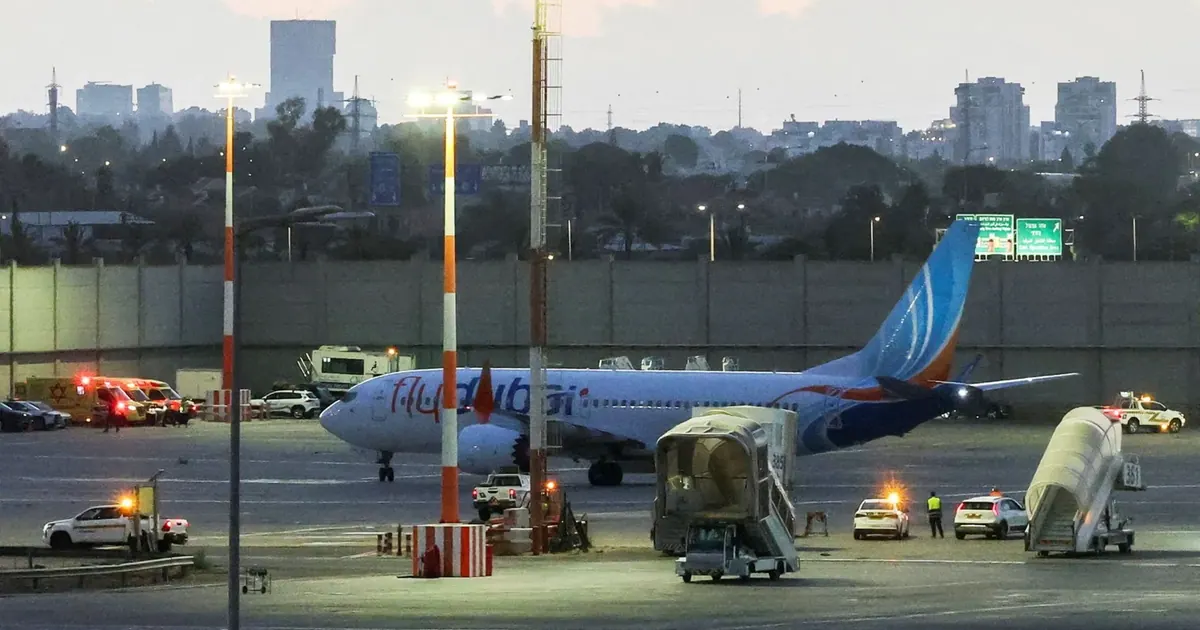
The co-pilot of a flydubai plane who attempted to hijack the aircraft last Wednesday planned to crash it into Tel Aviv's Ben Gurion airport or a tower block in the Israeli city. According to US and Israeli reports, Hamam al-Hammami, an Omani national, intended to continue flying the plane as normal into Israeli airspace and receive landing clearances before crashing it. The incident occurred on flight FZ1073 from Dubai to Tel Aviv, which was diverted to land in Saudi Arabia after al-Hammami attacked and wounded the captain with an emergency crash axe.
Al-Hammami's plan was similar to al-Qaeda's 11 September 2001 attacks in the US, with the co-pilot intending to crash the Boeing 737 MAX, which had over 180 passengers on board, into the airport or a central Tel Aviv tower block. Israeli media cited sources with knowledge of the investigation as saying al-Hammami was likely acting alone, rather than on behalf of a radical organisation or foreign government. The co-pilot also reportedly told investigators that he had intended to hijack and crash a previous flight to Tel Aviv but changed his mind because he knew someone on board.
The UAE's attorney-general, Hamad al-Shamsi, has said that al-Hammami attempted to carry out a "terrorist act" on the flight. Israeli Prime Minister Benjamin Netanyahu has stated that al-Hammami underwent "Islamist radical indoctrination" and that the captain, passengers, and a second crew prevented "a 9/11 disaster". The incident has raised questions about major security lapses, including how al-Hammami was recruited by flydubai and given clearance to fly a plane filled with Israelis to Tel Aviv.
Regional officials have revealed that al-Hammami was barred from flying by Oman's national carrier, Oman Air, due to concerns about his extremist views. He was later hired by UAE-based flydubai after undergoing standard security checks that did not examine his background for potential signs of radicalisation. Israeli aviation regulations state that pilots who are citizens of countries without formal diplomatic relations with Israel, like Oman, are not permitted to operate flights to the country.
The incident has also highlighted security oversight issues, with Israel's Shin Bet domestic security agency and the Mossad foreign intelligence agency responsible for vetting passenger and crew lists from foreign airlines. However, Transport Minister Miri Regev has stated that her ministry was not given the lists for flight FZ1073, and that security oversight for flights operated by foreign airlines fell under the remit of the Shin Bet and the Mossad.
Israeli authorities are continuing to investigate al-Hammami, who is being held in the UAE. The Israeli Prime Minister has instructed the head of the National Security Council to review "all security aspects regarding foreign civil aviation to Israel". Australian authorities are also investigating al-Hammami's links to Australia, where he studied between 2015 and 2017.
The UAE's attorney-general has stated that investigations will continue to establish the full circumstances, motives, and any links related to the incident. The results of the investigation will be announced upon their conclusion. The incident has sparked widespread concern about airline security and the potential for radicalised individuals to infiltrate the aviation industry.
Key points
- Flydubai co-pilot Hamam al-Hammami planned to crash the plane into Tel Aviv's Ben Gurion airport or a tower block in the Israeli city.
- Al-Hammami was likely acting alone and had intended to hijack and crash a previous flight to Tel Aviv but changed his mind.
- The incident has raised questions about major security lapses and oversight issues in the aviation industry.