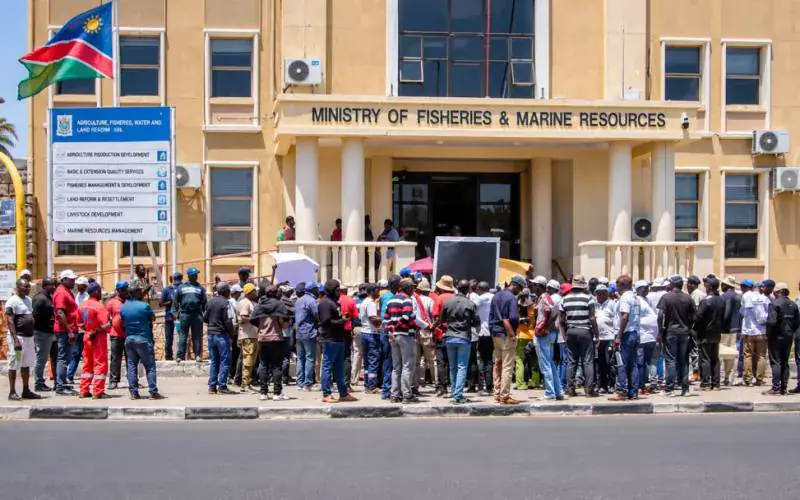
The Government Employment Redress Programme (GERP) in Namibia is set to conclude on 31 October, but workers covered by the initiative are seeking a settlement of outstanding employment claims. The Mining, Metal, Maritime and Construction Workers Union (MMMCWU) has petitioned the ministry of agriculture, fisheries, water and land reform over unpaid overtime, night-shift allowances, and severance pay on behalf of workers from more than 13 fishing companies.
The grievances affect workers who lost their jobs following industrial action in 2015 and were later accommodated under GERP. Introduced in 2020, the programme used fishing quota allocations to participating companies to create employment opportunities for affected workers. However, the workers say the arrangement has not resolved all their historical employment claims. Some workers remained with the companies because the government presented the programme as a permanent solution, only to later learn it was scheduled to end.
Union secretary general Joseph Garoeb is demanding six years' outstanding severance pay and says workers should not be expected to return to the companies while negotiations over their claims remain unresolved. Garoeb proposed that workers receive N$250 000 each to leave the programme by 1 November, provided they accepted the package. He also called for the programme to be placed on hold for a week to give the parties time to negotiate.
The ministry and the union agreed to keep the matter open while negotiations continue. The ministry was given five working days to consult and return with directives by the following Friday. Deputy executive director Ueritjiua Kauaria said the 1 November date did not automatically mean workers would become unemployed, adding that discussions could continue after the programme's scheduled end.
GERP's closure follows a government review of the programme. In April, President Netumbo Nandi-Ndaitwah said it was scheduled to conclude in April 2027, at the end of its planned seven-year duration. However, the government subsequently brought forward the termination date to 31 October, following a performance audit and a Cabinet decision.
The ministry has said the programme had 2,255 beneficiaries, of whom 1,343 were actively employed and 912 were not actively employed, according to figures released in August. The ministry acknowledged that implementation challenges existed but maintained that GERP had achieved its primary purpose as an extraordinary government intervention to protect jobs, preserve livelihoods, and provide relief to workers affected by the industrial action and subsequent company closures.
The programme's winding down has involved arrangements for companies to absorb workers into permanent employment where possible. Under the transition arrangements, companies taking workers into permanent employment were expected to retain them for at least 12 months. The union's latest petition raises questions over how outstanding employment claims will be settled alongside those exit arrangements, with Garoeb's proposed N$250 000 package remaining a demand by the union.
Key points
- Workers covered by GERP are seeking a settlement of outstanding employment claims as the programme ends.
- The union is demanding six years' outstanding severance pay for workers.
- The programme's closure has involved arrangements for companies to absorb workers into permanent employment where possible.