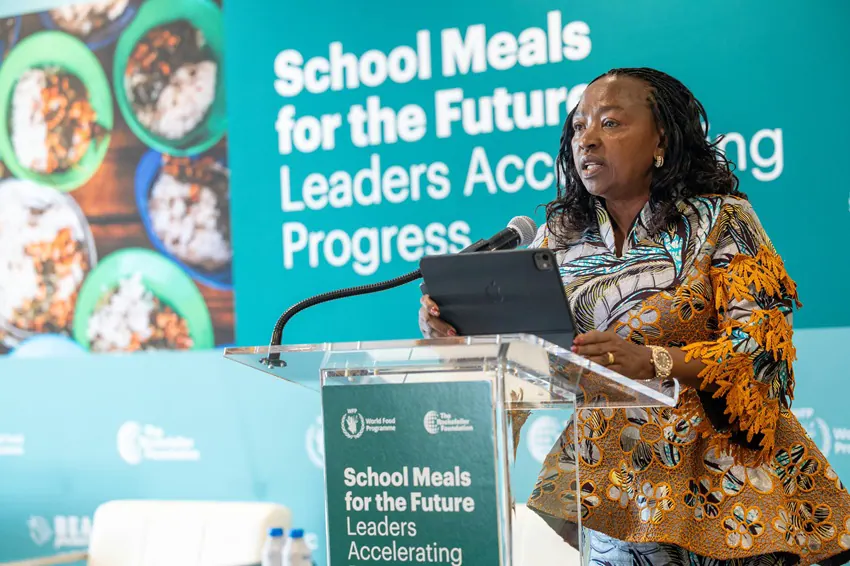
First Lady Rachel Ruto has urged global partners to support Kenya's school meals drive, aiming to reach 10 million learners by 2030. Speaking in New York during a meeting with the World Food Programme (WFP) and The Rockefeller Foundation, Mrs Ruto emphasized that a nutritious meal can strengthen education, improve farmers' incomes, and advance climate action. She noted that Kenya's school meals programme has expanded from 1.8 million learners in 2023 to about 2.6 million.
Mrs Ruto highlighted that Kenya's school meals programme is a result of a long national journey, from the Maziwa ya Nyayo initiative to the current nationally owned programme. The WFP had previously supported Kenya's school feeding programme before the Government assumed full ownership, and now provides technical support to strengthen and expand the programme. Mrs Ruto also mentioned that the Government is deepening the programme through initiatives such as the Mama Kitchen Garden Initiative and the National School Milk Programme.
The First Lady cited Kachororoni Primary School in Ganze, Kilifi County, as an example of a school that has successfully implemented school gardens to supplement meals, equip learners with practical food-growing skills, and build resilience in a community affected by drought and food insecurity. The school gardens initiative is being rolled out across all 47 counties, while the National School Milk Programme aims to improve children's nutrition and create a stable market for smallholder dairy farmers.
Mrs Ruto also highlighted ongoing nutrition interventions in counties including Migori, Nakuru, Kilifi, Baringo, and Makueni, with expansion planned in Uasin Gishu, Bomet, Kericho, Mombasa, and Trans Nzoia. Kenya joined the Global School Meals Coalition at its launch in 2021, and in October 2024, the Ministry of Education launched the National School Meals Coalition and an operational plan to scale up the national programme towards universal coverage by 2030.
The programme targets an increase from 1.9 million learners in 2023 to more than 10 million by 2030 and is expected to receive further legal backing through the proposed School Feeding Bill currently before Parliament. Mrs Ruto emphasized that the expansion is particularly urgent in arid and semi-arid counties, where food insecurity, drought, and the cost of preparing meals remain major barriers to learning.
However, Mrs Ruto noted that financing remains a major challenge, with the national school meals programme facing a Sh6.6 billion funding shortfall. She also highlighted the need to make school feeding more climate-friendly, noting that many schools continue to rely on wood biomass for cooking. Kenya is developing an investment-ready clean-cooking pipeline and seeking partnerships to demonstrate how clean cooking can deliver both climate and development benefits.
Mrs Ruto concluded that a school meal can nourish a child, sustain a farmer, protect a forest, and strengthen a nation. She urged international partners to work with Kenya to demonstrate how school meals can simultaneously address nutrition, agriculture, environmental conservation, and community resilience.
Key points
- First Lady Rachel Ruto calls for global partnerships to support Kenya's school meals drive
- Kenya aims to expand school meals to 10 million learners by 2030
- Financing remains a major challenge for the national school meals programme