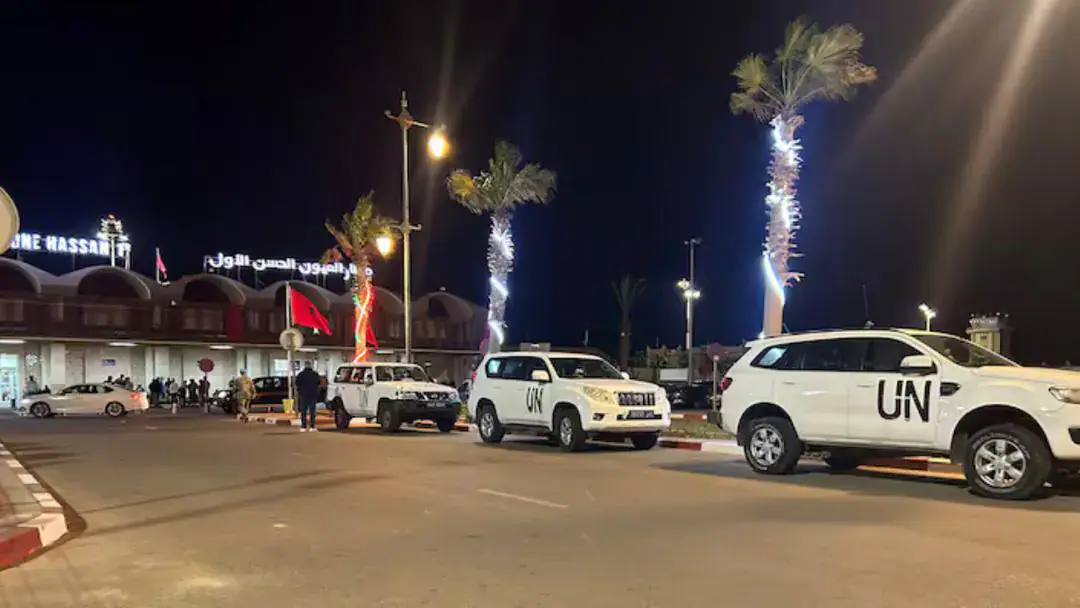
The withdrawal process of the United Nations Mission for the Referendum in Western Sahara (MINURSO) has begun with the departure of the first contingent from Laâyoune on November 16. This marks the initial phase of the withdrawal process following the expiration of the mission's mandate on October 31. According to the Moroccan news agency MAP, the withdrawal process is proceeding in an orderly and progressive manner.
The decision to withdraw MINURSO was made after the UN Security Council failed to renew the mission's mandate. A meeting chaired by King Mohammed VI on November 4 examined the modalities for the cessation of the mission's activities. The Moroccan Interior Ministry's coordination office with MINURSO was tasked with supervising the withdrawal and liquidation process in concertation with UN services.
The withdrawal process aims to ensure a smooth and orderly departure of civilian and military personnel, as well as the transfer of equipment and material assets. The Moroccan government has assured that the end of MINURSO's activities does not affect its commitment to the ceasefire. Morocco reiterates its attachment to this commitment, respecting its territorial integrity, national security, and citizens' tranquility.
The Royal Cabinet's communiqué on November 4, 2026, reiterated Morocco's firm commitment to the ceasefire, describing it as a voluntary engagement that will not change with the end of the UN mission's mandate. The Moroccan authorities view the withdrawal process as a continuation of the kingdom's historical engagement and doctrine in maintaining peace.
The MINURSO mission was established to oversee a referendum in Western Sahara, but its mandate has been repeatedly extended without achieving its primary objective. The mission's inability to monitor the ceasefire and establish the consequences of its violations has been cited by Moroccan authorities as a reason for the withdrawal.
The withdrawal of MINURSO is taking place in a context where Morocco maintains its position on Western Sahara, emphasizing its sovereignty over the territory. The Moroccan government has consistently maintained that the issue of Western Sahara is a matter of national sovereignty and territorial integrity.
The international community, including the African Union and the European Union, has been following the developments in Western Sahara with concern. The situation remains complex, with ongoing efforts to find a lasting solution to the conflict. The withdrawal of MINURSO is likely to have implications for the future of the region and the search for a peaceful resolution.
Key points
- Moroccan King Mohammed VI chaired a meeting on November 4 to examine the modalities for the cessation of MINURSO's activities.
- The withdrawal process of MINURSO is proceeding in an orderly and progressive manner.
- Morocco reiterates its commitment to the ceasefire, despite the end of MINURSO's mandate.