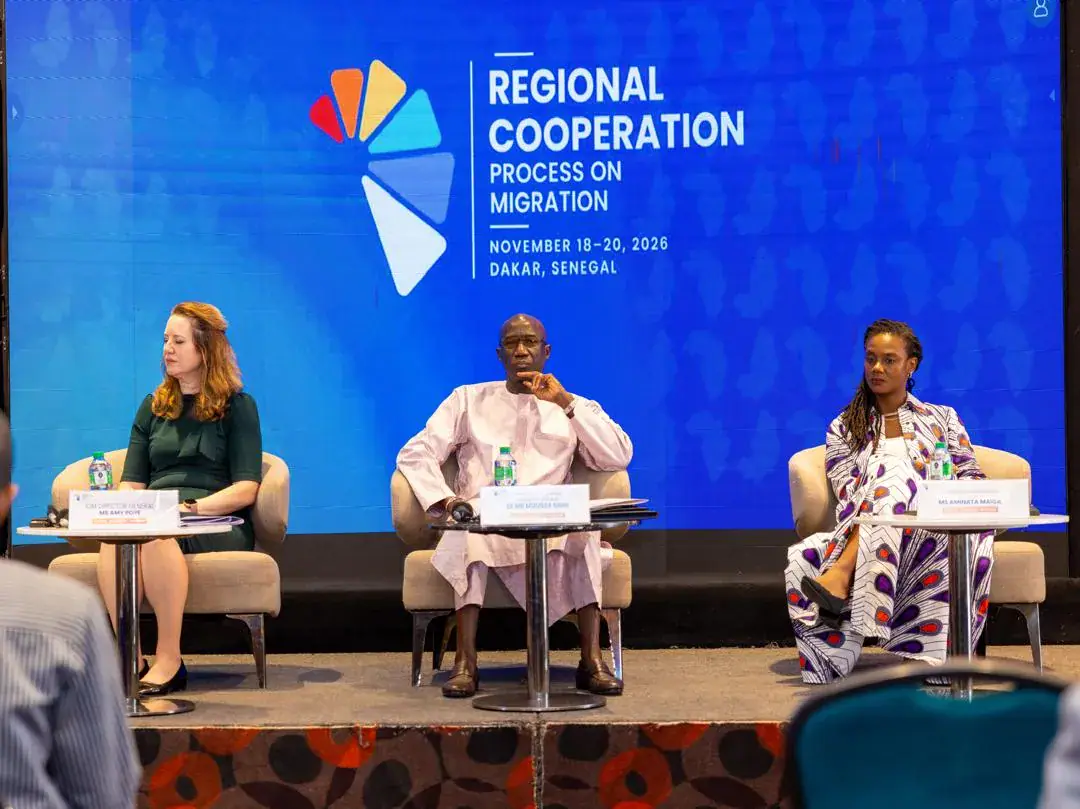
Fifteen West African countries have adopted the Dakar Declaration, a landmark agreement aimed at strengthening regional cooperation on migration issues. The declaration was finalized during a two-day ministerial conference in Dakar, Senegal, which concluded on November 21, 2026. The agreement outlines common commitments to improve migration governance, protect migrants' rights, and promote economic development. The Dakar Declaration is a significant step towards addressing the challenges of irregular migration in West Africa.
The ministerial conference was organized by the Senegalese government in collaboration with the International Organization for Migration (IOM). The conference brought together representatives from 15 West African countries, who agreed to enhance their cooperation on migration issues. The Dakar Declaration and a roadmap for 2027-2028 were adopted to provide a framework for concerted action against migration challenges in the region. The roadmap includes the designation of national focal points, pilot actions, and follow-up mechanisms.
The Dakar Declaration focuses on three key areas: migration governance and regional cooperation, protection of migrants and access to services, and the linkages between mobility, regional integration, and development. According to Dieynaba Touré Bathily, Director of Legal and Consular Affairs at the Senegalese Ministry of African Integration, Foreign Affairs, and Senegalese Abroad, the declaration formalizes common political commitments around these priorities. The declaration aims to strengthen cooperation at borders and between consular services.
The Dakar Declaration also seeks to facilitate regular circulation, ensure continuity of migrant protection, and promote professional mobility based on fair recruitment and recognition of skills. A roadmap has been adopted to translate these commitments into action, including the deployment of pilot actions and follow-up mechanisms over two years. The roadmap also outlines procedures for practical cooperation, such as document verification, transit of voluntary migrants, and transmission of alerts related to maritime surveillance.
IOM Director-General Amy Eileen Pope emphasized the need for collective action against migrant trafficking and smuggling networks. She recalled that no country can tackle these networks alone and advocated for better-organized migration, which can be a lever for employment and economic development. Pope highlighted the plight of young people and women who fall victim to false job promises.
Senegalese Justice Minister Me Moussa Sarr, who presided over the closing ceremony, welcomed the adoption of the Dakar Declaration. He stressed the importance of judicial cooperation between West African countries in the fight against migrant trafficking and smuggling. Sarr reiterated Senegal's commitment to making the prevention of irregular migration a priority.
The adoption of the Dakar Declaration marks a significant step towards addressing migration challenges in West Africa. The declaration and roadmap will serve as a framework for regional cooperation on migration issues. West African countries have committed to enhancing their cooperation to address the root causes of irregular migration and promote economic development.
Key points
- The Dakar Declaration aims to strengthen regional cooperation on migration issues in West Africa.
- The declaration focuses on migration governance, protection of migrants, and the linkages between mobility and development.
- A roadmap has been adopted to translate the commitments into action, including pilot actions and follow-up mechanisms over two years.