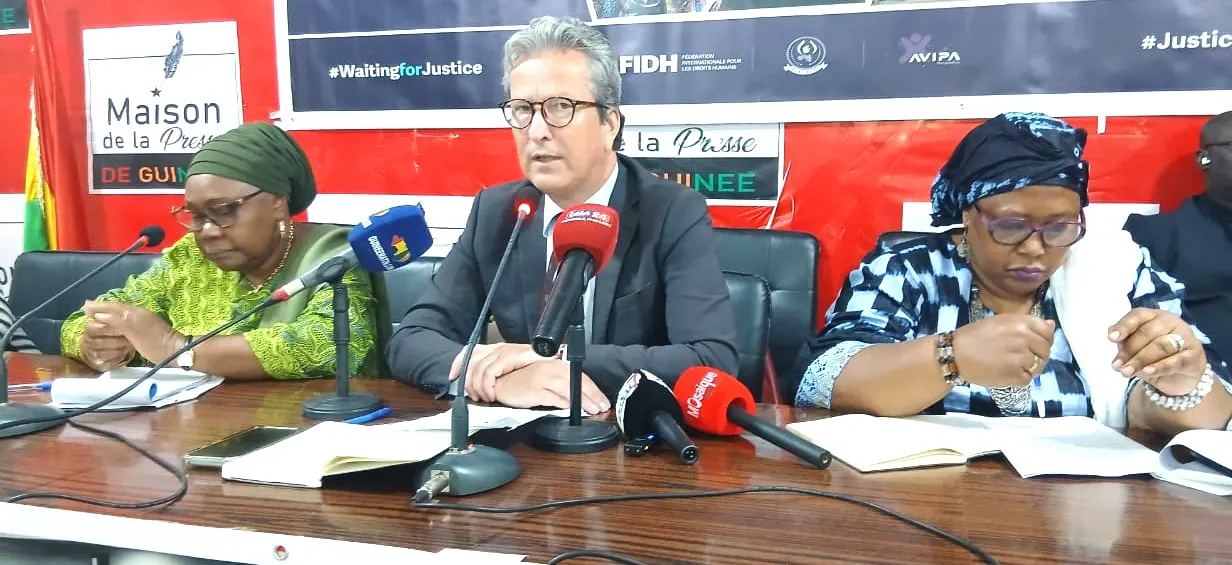
The International Federation for Human Rights (FIDH) has called on Guinean authorities to complete the justice process for the 2009 massacre victims. On September 28, the FIDH held a press conference in Conakry to mark the 17th anniversary of the massacre. The organization welcomed the trial's progress but expressed concerns about the judicial process, victim compensation, and public freedoms in Guinea. FIDH President Alexis Deswaef emphasized that the process cannot stop at the judgment already rendered.
The 2009 massacre occurred on September 28, when security forces stormed a stadium in Conakry, killing over 150 people and injuring hundreds more. The FIDH and other human rights organizations have been pushing for justice and accountability ever since. While a trial was held and some convictions were handed down, the FIDH is concerned that the process is not yet complete. The organization's president, Alexis Deswaef, met with Prime Minister Amadou Oury Bah and Conakry's prosecutor general, Fallou Doumbouya, to convey these concerns.
One of the main concerns is the presidential pardon granted to Moussa Dadis Camara, the main defendant, while the judicial process was still ongoing. Additionally, the deaths in detention of accused individuals Claude Pivi and Aboubacar Diakité, also known as Toumba, have raised questions among human rights organizations. The FIDH is calling for the appeal trials of the accused to be opened, stating that there are no more excuses for delaying the process.
The FIDH also raised concerns about the memory of the victims and the renovated stadium where the massacre occurred. The organization is asking what place will be reserved for the victims in the renovated stadium, which was set to be inaugurated on the eve of a Guinea-Kenya match. Alexis Deswaef asked if a commemorative plaque or a dedicated space for the victims will be included in the renovation.
The issue of compensation for victims remains a significant concern. Asmaou Diallo, president of the Association of Victims, Parents, and Friends of September 28, 2009 (AVIPA), stated that by May 2026, fewer than 200 victims had received compensation. The AVIPA is calling for the publication of an updated list of the compensation process, clear communication on the criteria used, and effective access to appeal mechanisms.
Beyond the September 28 case, the FIDH expressed concerns about the restriction of civic and democratic space in Guinea. The organization cited the dissolution of several political parties, the closure of high-audience media outlets, restrictions on the right to assembly and manifestation, and difficulties faced by some civil society organizations in obtaining their accreditation.
The FIDH also raised the issue of enforced disappearances and the discovery of mass graves. Alexis Deswaef stated that he directly addressed the issue with the Prime Minister and the prosecutor general. The FIDH is calling for independent and thorough investigations into these matters, including DNA sampling to identify bodies and determine if they are linked to missing persons.
Key points
- FIDH urges Guinean authorities to complete the justice process for 2009 massacre victims.
- The organization raises concerns about victim compensation and public freedoms in Guinea.
- FIDH calls for investigations into enforced disappearances and mass graves.