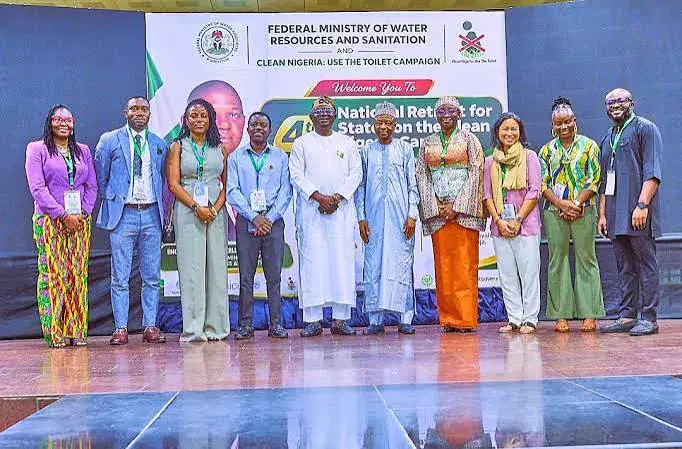
The Federal Government of Nigeria has called on private sector organizations to support its efforts to end open defecation in the country through their Corporate Social Responsibility (CSR) programs. This appeal was made by the Minister of Water Resources and Sanitation, Prof. Joseph Utsev, at the 6th National Retreat for States on the Clean Nigeria Campaign (CNC) in Abuja. The retreat's theme was 'Accelerating and Sustaining Progress: Financing, Data and Systems for an ODF Nigeria'.
Prof. Utsev emphasized that sustainable sanitation requires stronger collaboration among the Federal, State and Local Governments, development partners, civil society organizations and the private sector. He noted that government resources alone are insufficient to address the country's sanitation challenges and urged businesses to complement public funding through strategic partnerships and investments. The minister also called on all tiers of government to make deliberate budgetary provisions for sanitation.
According to Prof. Utsev, 185 Local Government Areas (LGAs) have attained Open Defecation-Free (ODF) status since the inauguration of the Clean Nigeria Campaign in November 2019. However, this achievement is below expectations, and the government is working to accelerate progress and exceed 400 ODF LGAs by 2027. President Bola Tinubu has signed the Executive Order on Open Defecation-Free Nigeria to strengthen the policy and institutional framework for achieving this target.
The National Coordinator of the Clean Nigeria Campaign, Mrs Chizoma Opara, also called for increased private sector participation, particularly through CSR initiatives and innovative financing arrangements. She identified inadequate and unpredictable financing, household poverty and affordability barriers as major challenges to achieving the country's ODF targets. Nigeria had targeted 172 ODF LGAs by December 2025 but achieved 162, falling short of the target by 10.
Mrs Opara outlined the campaign's six strategic pillars as an enabling environment, public financing, service delivery, ministerial leadership and advocacy, monitoring and evaluation, and effective coordination. The campaign is targeting at least 300 ODF LGAs by 2027 and at least three additional states achieving ODF status. Kano, Benue and Bauchi are among the states being supported to accelerate progress, while Sokoto is also making progress.
Other stakeholders, including the Country Director of Self Help Africa, Mrs Joy Aderele, and UNICEF's WASH Manager, Ms Jolly Maulit, commended the Federal Ministry of Water Resources and Sanitation and the Clean Nigeria Campaign Secretariat for their leadership and commitment to improving sanitation. They emphasized the need for stronger community monitoring and institutional accountability to sustain ODF gains and prevent communities from returning to open defecation.
The World Health Organisation (WHO) Representative, Dr Edwin Isotu-Edeh, noted that a large proportion of Nigeria's population still practices open defecation, leaving affected communities vulnerable to cholera and other diseases. He called for improved access to handwashing facilities and sustained hygiene promotion as part of the Clean Nigeria Campaign. The FCT is working towards achieving statewide ODF status by 2027, with over 300 communities in Kwali Area Council already certified ODF.
Key points
- The Nigerian government seeks private sector support to end open defecation through CSR programs.
- 185 LGAs have attained ODF status since 2019, but progress is below expectations.
- The government aims to exceed 400 ODF LGAs by 2027.