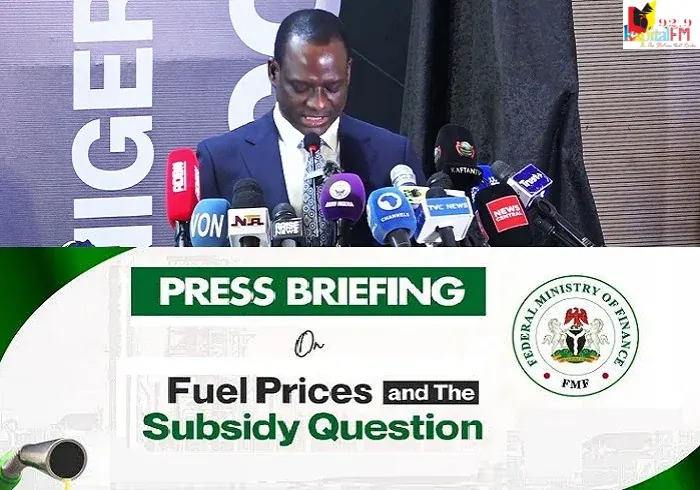
The Federal Government of Nigeria has firmly rejected calls to reinstate fuel subsidies, warning that such a policy would exacerbate the country's economic challenges and potentially lead to even higher petrol prices. According to the Minister of Finance and Coordinating Minister of the Economy, Taiwo Oyedele, the current surge in petrol prices is largely attributed to a global energy shock resulting from the conflict in the Gulf.
Oyedele explained that the global energy shock has caused Brent crude to rise above $100 per barrel, while disruptions to shipping through the Strait of Hormuz and reduced supplies of refined products have increased global fuel costs. As a result, petrol prices in Nigeria have skyrocketed from approximately 830 naira to an average of 1,400 naira per litre since the conflict began. The Minister emphasized that restoring petrol to its pre-reform price would be extremely costly.
The Minister stated that restoring petrol to its pre-reform price would cost the government over 20 trillion naira annually, while a 500 naira per litre subsidy could cost more than 16 trillion naira a year. He warned that such expenditure could undermine funding for essential public services, including salaries, pensions, infrastructure, healthcare, education, and security.
Oyedele highlighted that the removal of subsidies has released 15.8 trillion naira to the Federation Account between June 2023 and December 2025, with 10.4 trillion naira allocated to states and local governments. He noted that these savings have supported higher wages, infrastructure development, electricity subsidies, and social transfers, demonstrating the positive impact of the subsidy removal.
To mitigate the effects of high fuel prices, the government has introduced several measures. These include tax and duty waivers on petroleum products, naira-for-crude arrangements for local refiners, stronger market oversight, and the expansion of compressed natural gas (CNG). The Minister reported that over 120,000 vehicles now run on CNG, indicating a significant shift towards alternative fuel sources.
The government has announced additional measures to cushion the impact of high fuel prices. These measures include a 30-day margin discount at NNPC stations, with priority given to public transporters. The government is also negotiating a 1,350 naira ceiling on the ex-gantry or landing cost of petrol. Furthermore, the government plans to increase cash transfers and subsidized credit, accelerate CNG deployment, and take action against illegal levies.
In the long term, the government plans to establish a National Strategic Fuel Reserve to stabilize fuel prices. The Minister also mentioned that the government would consider implementing an excess profit tax on operators taking undue advantage of consumers. These measures aim to provide targeted and sustainable relief without reverting to a blanket fuel subsidy, ensuring that the most vulnerable populations are protected from the adverse effects of high fuel prices.
Key points
- The Nigerian government has rejected calls for a return to fuel subsidies.
- The current rise in petrol prices is driven by a global energy shock.
- The government has introduced measures to cushion the impact of high fuel prices.