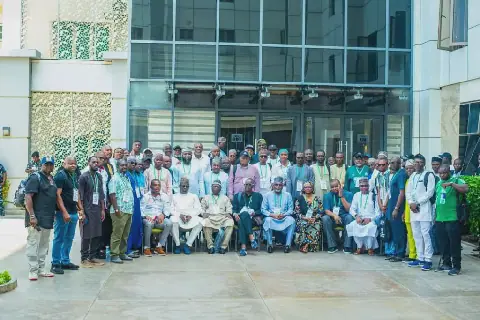
The Federal Government of Nigeria has set a target to create one million export-linked jobs and produce 10 million globally certified Nigerians by 2030. This goal is part of the government's efforts to reform the education and skills development sector. According to Dr. Tunji Alausa, Minister of Education, the Federal Ministry of Education is playing a key role in building a talent pipeline linked directly to global employment opportunities.
Dr. Alausa made this statement at the "Hire From Nigeria" side event on the margins of the 81st United Nations General Assembly in New York. He emphasized that Nigeria's youthful population, English-language advantage, cultural adaptability, and growing digital capabilities provide a strong foundation for participation in the global services economy. The minister highlighted that Nigeria's greatest asset is its people, a young, ambitious, English-speaking, and increasingly digitally capable population.
However, Alausa identified some challenges that need to be addressed, including the gap between training and evolving employer demand, limited work-based learning opportunities, and access to internationally recognized certification. To address these challenges, the ministry is working on curriculum reform, stronger accreditation and quality assurance, as well as expanded digital and technical training. The minister stressed the need for a permanent employer-led feedback loop to ensure that training programs meet employer demands.
The Federal Government's free Technical and Vocational Education and Training (TVET) program has attracted over one million applications, with 160,000 trainees supported through about 1,200 centers nationwide. These centers include Federal Technical Colleges and accredited private training centers. The government is also promoting multiple pathways to employment and enterprise through university education, TVET, apprenticeships, and continuous upskilling.
Alausa emphasized that preparing young Nigerians for an economy increasingly shaped by artificial intelligence and advanced technologies is a priority. The focus is on skills that complement technology, including judgment, creativity, domain knowledge, data literacy, cybersecurity, cloud services, software development, customer success, and quality assurance. The Digital Training Academy is partnering with global learning providers to provide 32,000 Nigerians with free access to professional digital and technology training.
The minister disclosed that the Student Venture Capital Grant is supporting students in Science, Technology, Engineering, Mathematics, and Medicine (STEMM) disciplines to translate innovative ideas into viable enterprises. Alausa urged international employers, Business Process Outsourcing (BPO) operators, investors, and development partners to invest in Nigeria's talent pipeline and support the education reform agenda.
The ministry's reform agenda seeks to align education with President Bola Tinubu's Renewed Hope Agenda, focusing on human capital development, job creation, skills acquisition, and inclusive economic growth. The ministry aims to build an education and skills system that connects Nigerian talent to opportunities, strengthens Nigeria's position in the global economy, and enables young Nigerians to build sustainable careers at home and abroad.
Key points
- The Federal Government aims to produce 10 million globally certified Nigerians by 2030.
- The government is working to create one million export-linked jobs through education and skills development reforms.
- The ministry is promoting multiple pathways to employment and enterprise through university education, TVET, apprenticeships, and continuous upskilling.