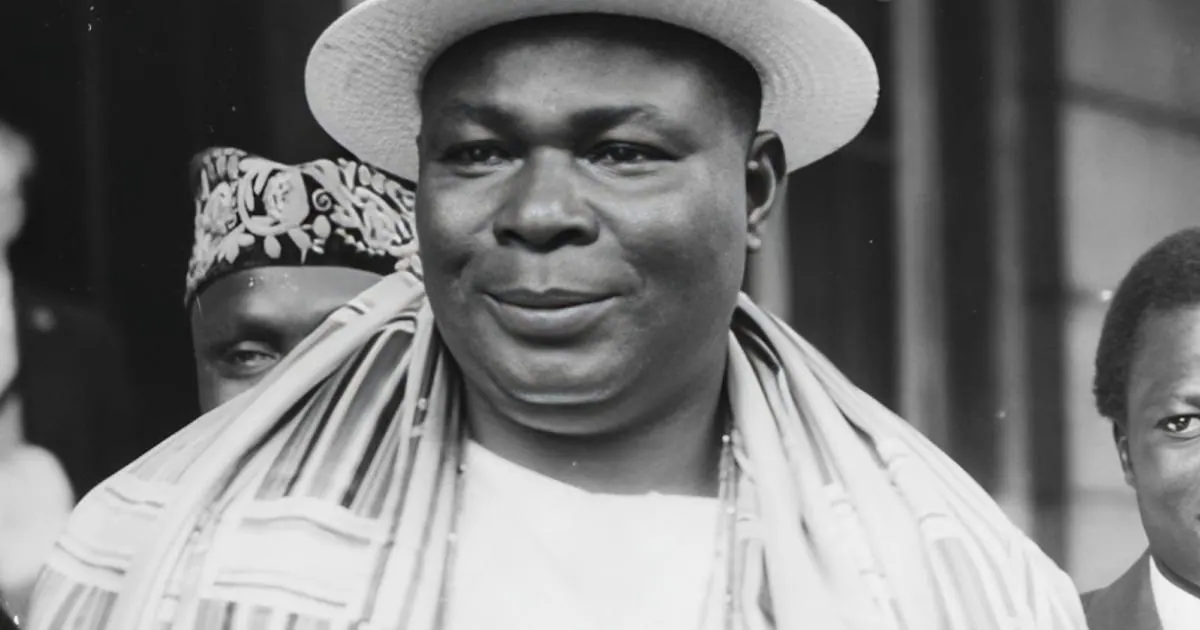
Chief Festus Okotie-Eboh, a prominent figure in Nigeria's First Republic, was a politician, businessman, and fashion icon. He served as Nigeria's first and longest-serving Federal Minister of Finance for over eight years. Okotie-Eboh was known for his flamboyant style, which earned him a place in Nigeria's political history. His colourful suits and accessories often made him the centre of attention, including during Queen Elizabeth II's 1956 visit to Nigeria.
Okotie-Eboh was born Samuel Edah on July 18, 1912, at Benin River in the Warri Division. He was adopted by Prince Okotie-Eboh, after which he took the family name. His early journey was far from the political spotlight. He attended Sapele Baptist Primary School between 1932 and 1936 and later returned there as a teacher in 1937. He left the classroom and joined the British Bata Shoe Company Limited, where he started as a clerk and eventually rose to become Chief Clerk.
Okotie-Eboh's business career began to take shape when he travelled abroad for professional training and earned a Diploma in Business Administration and Organisation. The experience helped him develop the business skills that later made him one of Nigeria's wealthiest politicians. He became a rubber merchant and timber businessman and established several businesses, including schools and factories. Some of his ventures included Okotie-Eboh Grammar School and Omimi Plastic and Shoe Factories.
Okotie-Eboh officially entered politics in 1951 after contesting elections and becoming a member of several local bodies. He quickly became a major political force in the region and was never defeated in local elections in Warri or Sapele. A member of the National Council of Nigerian Citizens (NCNC), he became Chief Whip in the Western Regional House of Assembly in 1954 before being appointed Federal Minister of Labour and Social Welfare in 1955.
Okotie-Eboh's political journey reached its peak in 1957 when he became Nigeria's Minister of Finance, a position he held for eight years, four months, and 16 days. As Nigeria's Finance Minister, Okotie-Eboh represented the nation abroad in discussions with international diplomats and foreign figures. During his time as Finance Minister, Okotie-Eboh played a major role in shaping Nigeria's economic structure.
Okotie-Eboh was involved in the establishment of the Central Bank of Nigeria in 1959, the introduction of Nigeria's first national currency, the creation of the Nigerian Stock Exchange, and the formation of the Nigerian Investment and Development Bank. He maintained a personal relationship with the 35th President of the United States, John F. Kennedy. His international exposure, business background, and political influence made him one of Nigeria's most recognised figures during the independence era.
On January 15, 1966, Nigeria experienced its first military coup, which ended the First Republic. The coup claimed the lives of several political leaders, including Prime Minister Sir Abubakar Tafawa Balewa and Chief Festus Okotie-Eboh. Okotie-Eboh was the only Federal Cabinet Minister killed during the coup. At the time of his death, he was survived by his wife and 14 children, many of whom were still very young.
Key points
- Chief Festus Okotie-Eboh was a key figure behind major national institutions, including the Central Bank of Nigeria and the Nigerian Stock Exchange.
- Okotie-Eboh served as Nigeria's first and longest-serving Federal Minister of Finance for over eight years.
- He was known for his colourful fashion style and wealth, which made him one of Nigeria's most famous politicians of the First Republic.