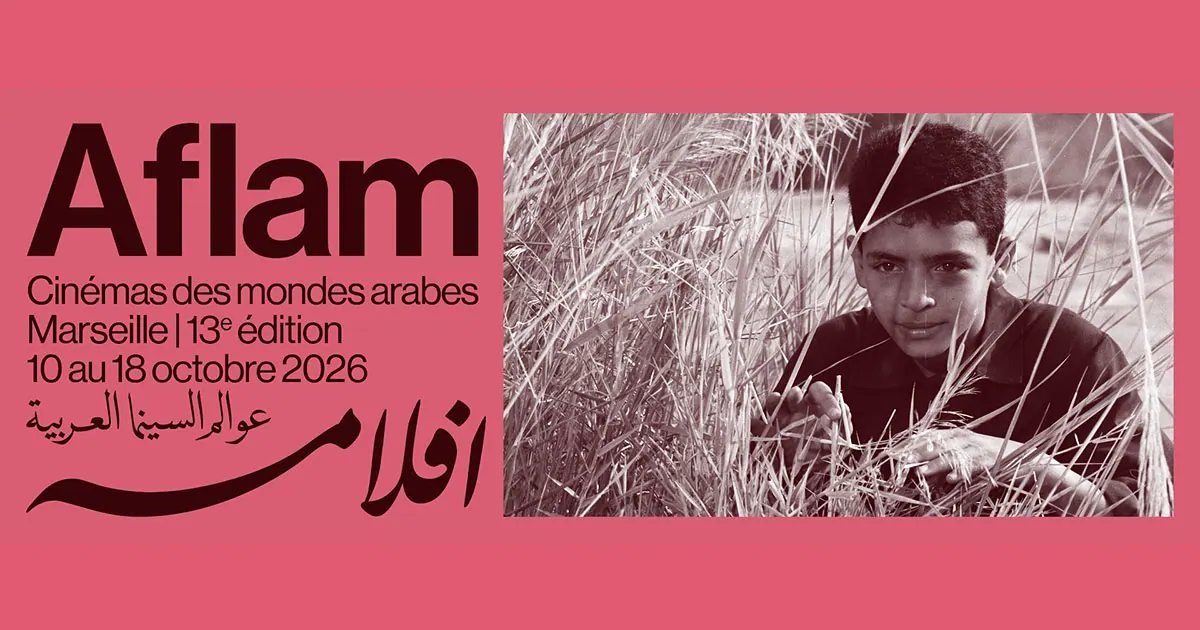
The 13th edition of the Aflam festival, titled "Réparer l'image" (Repairing the Image), will take place in Marseille, France, from October 10 to 18, 2026. The festival, organized by the Aflam association, will feature 52 films, 40 guests, and 35 events. This year's theme aims to repair the image by refusing to condemn any memory to silence. The festival will explore the archives of Algeria, Tunisia, and minority memories.
The festival will pay special attention to Algerian cinema, with a selection of restored films presented by Nabil Djedouani, head of the Algerian Digital Cinema Archives. Djedouani has been working on preserving and disseminating Algerian films that have become difficult to access since 2012. On October 11, a screening of "Boualem Zid El Goudam" by Moussa Haddad, made in 1980, will be presented in the presence of Djedouani. The film explores the country's post-colonial history and the contradictions of Algerian society.
The festival will also feature Tunisian cinema, with a short archive dedicated to Sousse, shot in 8mm in 1971, presented on October 17 at the Mucem. This modest image acquires a new value over time, becoming a fragment of Tunisia's heritage. Tunisia will also be represented through the WarshatAflam, a screenwriting residency for young filmmakers from the Arab world.
Palestine will have a strong presence at the festival, with a meeting titled "Les révolutionnaires ne meurent jamais: cinéastes solidaires du peuple palestinien" (Revolutionaries Never Die: Filmmakers in Solidarity with the Palestinian People) on October 15. The event will feature Kassem Hawal and Mohanad Yaqubi, among others. The Palestinian archives testify to a history constantly threatened by wars, displacement, and destruction.
The festival will also explore the cinema of other countries, including Lebanon and Morocco. "Le Jour de colère: Contes de Tripoli" by Rania Rafei will retrace the contemporary history of Lebanon, from the 1943 protests to the popular mobilizations of 2019. Morocco will be represented through the Archives Bouanani, with Touda Bouanani and Marie Pierre-Bouthier.
The festival will also give visibility to minority memories, with an exhibition on Amazigh cinema in Morocco, designed and commented on by Sarah Mounia Kachiri. The exhibition will feature films, amateur videos, and installations around cultural identity, oral transmission, and forms of resistance. A roundtable discussion titled "Ce que le patrimoine culturel national invisibilise" (What National Cultural Heritage Makes Invisible) will bring together Chantal Partamian, Pauline Tucoulet, and Sarah Mounia Kachiri.
The Aflam festival aims to promote dialogue between old films and new works, national archives, and minority memories. The festival's program includes a mix of classic films, contemporary creations, and events that highlight the importance of preserving cultural heritage. By repairing the image, the festival seeks to give a voice to silenced memories and promote a more nuanced understanding of history.
Key points
- The 13th edition of the Aflam festival will focus on repairing the image and recovering memories, with a program that includes 52 films, 40 guests, and 35 events.
- The festival will pay special attention to Algerian and Tunisian cinema, as well as minority memories.
- The event aims to promote dialogue between old films and new works, national archives, and minority memories.