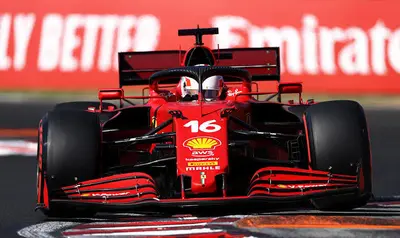
Ferrari's performance at the Singapore Grand Prix has raised concerns about the team's strategic decision-making and internal dynamics. The team's choice of tyre compounds and pit stops led to Lewis Hamilton finishing sixth, while teammate Charles Leclerc secured second place. Hamilton took full responsibility for the outcome, stating it was his call that led to the disappointing result. However, team principal Fred Vasseur confirmed that the instruction had been clear, and the result would likely have been second and third if Hamilton had obeyed the team order.
The Singapore Grand Prix highlighted a deeper dysfunction within Ferrari that has been a recurring issue for years. Ferrari entered the race with limited knowledge of tyre performance after a wet Sprint race, which led to a split strategy. Leclerc was given the softer tyre compound, while Hamilton was on mediums. The soft tyres proved to be significantly superior, forcing Hamilton into an early stop and a long second stint that became a liability. This strategic misstep ultimately led to Hamilton's sixth-place finish.
Hamilton's decision to override the team order and stay out on ageing softs during the Virtual Safety Car period was a critical turning point in the race. He was subsequently passed by Leclerc, Kimi Antonelli, Lando Norris, and Oscar Piastri. Vasseur confirmed that the team had intended for both cars to pit during the Virtual Safety Car period, but Hamilton chose not to. This incident has raised questions about the communication and trust between Hamilton and the Ferrari team.
The incident has sparked concerns about whether Hamilton is being treated as a genuine title contender or as a high-profile sparring partner to aid car development and generate data for Leclerc. The optics of the situation are not flattering, with Leclerc being given the stronger starting tyre and prioritized during the strategies. When the decisive Virtual Safety Car window opened, the team's preferred outcome required Hamilton's compliance, which was not forthcoming.
Ferrari's technical and operational capabilities remain strong, with the car showing pace in Singapore. However, the team's decision-making under pressure, communication clarity, and internal politics continue to be a concern. Hamilton did not join Ferrari to play second fiddle or serve as a development mule; he joined to win. The Singapore Grand Prix result has highlighted the need for Ferrari to simplify its strategy, improve communication, and treat both drivers equally.
The burden of the error in Singapore appeared to be carried almost entirely by Hamilton, rather than being shared by the organization that set the conditions for it. Hamilton's post-race apology and visible physical toll only sharpened the sense of disappointment. The bigger apology, however, should come from Ferrari itself, which put Hamilton in a position where the apology was necessary.
Ultimately, Ferrari's performance in Singapore has exposed a deeper dysfunction within the team that needs to be addressed. Until the team simplifies its strategy, improves communication, and treats both drivers equally, it will continue to manufacture its own disappointments. The question remains whether Ferrari can change its approach and fully commit to either driver as the clear No. 1, building every call around maximizing that driver's result.
Key points
- Ferrari's strategic missteps and internal dynamics hindered Lewis Hamilton's performance at the Singapore Grand Prix.
- Hamilton's decision to override team orders and stay out on ageing softs during the Virtual Safety Car period was a critical turning point in the race.
- The incident has raised concerns about whether Hamilton is being treated as a genuine title contender or as a high-profile sparring partner to aid car development and generate data for Leclerc.