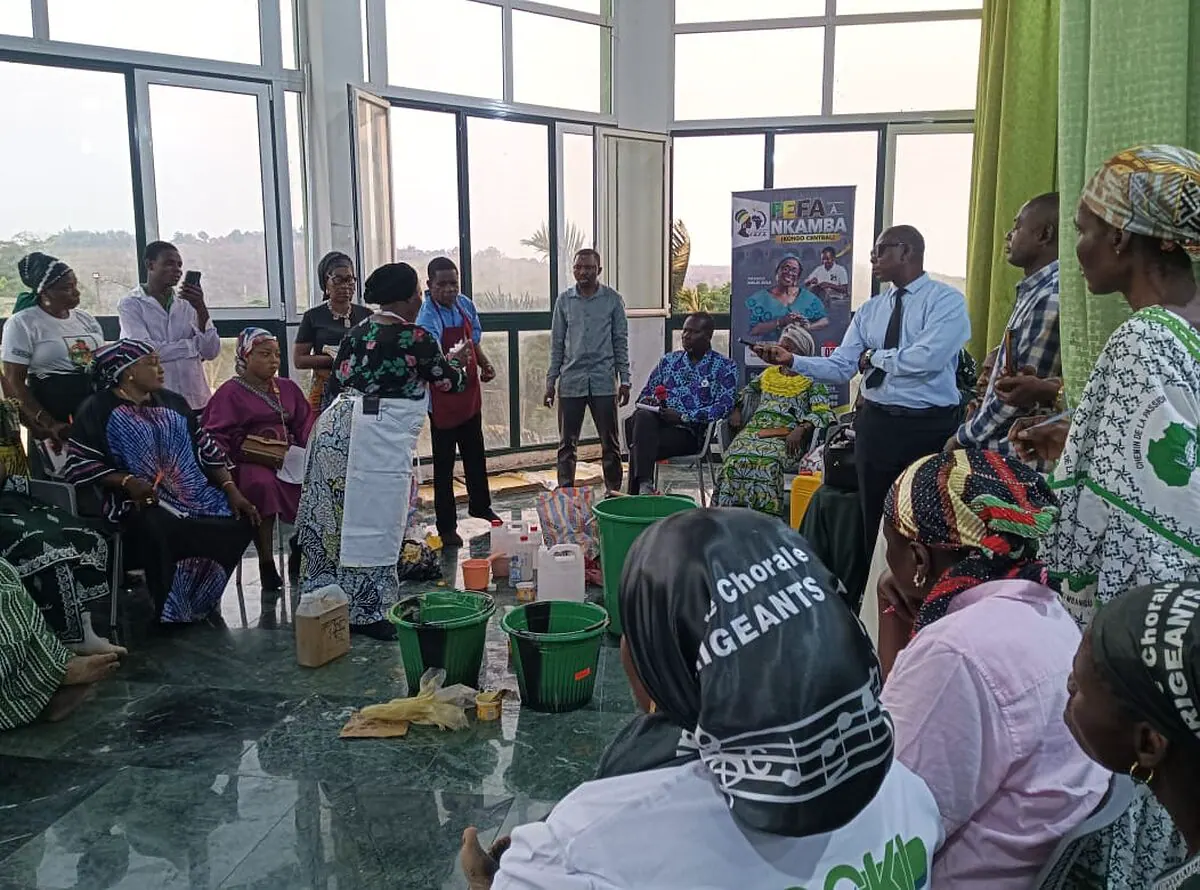
The Foire de l'Entrepreneuriat de la Femme Africaine (FEFA) recently concluded its first training session in Nkamba, Democratic Republic of the Congo. The session, which took place from October 7 to 10, 2026, at the Simon Kimbangu Museum, brought together nearly 100 participants. The initiative, led by Professor Émilie Zola, president of FEFA, aimed to strengthen the skills of participants and promote their economic autonomy.
The training program covered various topics, including entrepreneurship, financial education, environmental protection, and artisanal transformation. The program combined theoretical teachings with practical exercises, enabling participants to acquire knowledge and skills to develop income-generating activities while integrating sustainable development principles. The training also focused on the production of liquid soap and bleach, allowing participants to learn about the different stages of production and discover techniques to create small artisanal production units.
The closing ceremony was attended by FEFA committee members, participants, trainers, and representatives of ecclesiastical authorities. The program for the day was presented by Mboma Mangla Salomon, FEFA coordinator, before the opening prayer and the execution of the national anthem. An evaluation of the subjects taught was conducted, and the results showed a 95% success rate among participants. This performance is a positive indicator for an initiative that aims to promote entrepreneurship through training.
Professor Émilie Zola, FEFA president, also spoke during the closing ceremony. The platform aims to promote female and youth entrepreneurship in Africa by facilitating access to knowledge, acquiring practical skills, and emerging economically viable projects. The ceremony included the awarding of certificates to participants, marking the end of their training and rewarding their commitment throughout the sessions.
The event concluded with the official closing pronounced by the advisor to the Spiritual Leader, responsible for Culture, Arts, and Media, who represented the Spiritual Leader of the Kimbanguist Church. The ceremony ended with the execution of the national anthem and a family photo with organizers, trainers, ecclesiastical authorities, and beneficiaries. Participants expressed satisfaction with the knowledge acquired and its practical usefulness, with many requesting a new training session.
The first day of the session included presentations on environmental issues, sustainable development, and market functioning. Bibiche Mayanu, head of work at the University of Kinshasa (UNIKIN), discussed fundamental notions related to the environment and sustainable development. Crispin Nkosi Mfumunani, also a head of work at UNIKIN, gave a presentation on waste management, while Brigitte Kaputo, a teacher at the same university, discussed market principles in entrepreneurship.
With this first session in Nkamba, FEFA aims to establish itself as a structure for accompaniment, training, and valorization of economic initiatives. The organization seeks to go beyond the commercial exhibition framework and create a space for knowledge transmission and skills learning. By combining academic training, practical learning, and sustainable development awareness, FEFA aims to contribute to the emergence of entrepreneurs capable of valorizing local resources and creating income-generating activities.
Key points
- The FEFA training session in Nkamba achieved a 95% success rate among nearly 100 participants.
- The training program covered topics such as entrepreneurship, financial education, and environmental protection.
- The initiative aims to promote female and youth entrepreneurship in Africa and contribute to the development of local communities.