Fifty years ago, Nigeria made a historic decision to create a new Federal Capital Territory, Abuja, which was designed to be a symbol of the country's political identity and ambition. The decision was made in 1976, sixteen years after independence, under the military government of General Murtala Mohammed. The goal was to establish a centrally located capital, accessible to Nigerians from different parts of the country, and free from the geographical and administrative limitations of Lagos.
Abuja was not conceived as just another city, but as a national project, a planned capital that would embody Nigeria's unity and provide the necessary infrastructure, institutions, and environment for the seat of government. The Abuja Master Plan, designed in 1979, provided the framework for the development of the Federal Capital City, guiding land use, transportation, infrastructure, and residential communities. However, over the years, Abuja has grown beyond the assumptions of the original plan, facing challenges such as population growth, traffic congestion, and housing pressures.
Today, Abuja has developed into the political heart of Nigeria, with the government district, National Assembly, Supreme Court, and diplomatic missions. The city has undergone massive infrastructure development, with an expanding metropolitan population. Despite this, the Federal Capital Territory Administration is pursuing a review of the Abuja Master Plan to address new demands on the capital, including transportation, urban mobility, and sustainable development. This review aims to adapt the plan to the realities of a modern, rapidly expanding city.
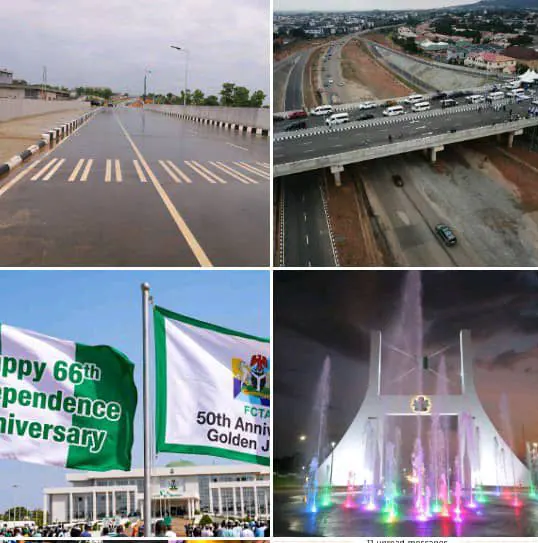
The Nyesom Wike-led administration, under President Bola Ahmed Tinubu, has emphasized infrastructure development across the capital, including roads, bridges, water projects, and judicial infrastructure. In 2023, the FCT Administration embarked on 31 days of project commissioning, including major roads and institutional infrastructure. Wike has stated that road connectivity is crucial for growth and development, and that the recent efforts to extend water infrastructure to satellite communities are a testament to Abuja becoming a capital city that works for all.
However, the success of Abuja over the next fifty years depends on whether urban planning can keep pace with population growth, and whether housing remains accessible to ordinary residents. The review of the Abuja Master Plan aims to address rapid population growth, development-control capacity, and planning distortions. The administration's efforts to bridge the gap between the original plan and the current realities of the city are crucial to ensuring that Abuja becomes a capital city that serves a growing population.
As Nigeria celebrates 66 years of independence and Abuja marks 50 years of its existence as the nation's Federal Capital, the story of Abuja is one of a dream still unfolding. The capital has achieved the fundamental objective of becoming the seat of Nigeria's Federal Government, but the continuing need to upgrade infrastructure and respond to rapid urban growth demonstrates that the Abuja project is far from finished.
The test for the Tinubu administration will be whether the projects commissioned form part of a coherent, long-term strategy that makes Abuja more connected, functional, and sustainable. Fifty years ago, Nigeria created Abuja with the hope of building a capital that would belong to all Nigerians. Today, that dream stands in concrete, steel, roads, bridges, institutions, and expanding communities, but it also lives in an unfinished plan, a reminder that a lot of work still needs to be done.
Key points
- Abuja has developed into the political heart of Nigeria, but faces challenges such as population growth and infrastructure development.
- The Federal Capital Territory Administration is reviewing the Abuja Master Plan to address new demands on the capital.
- The success of Abuja over the next fifty years depends on whether urban planning can keep pace with population growth and whether housing remains accessible to ordinary residents.