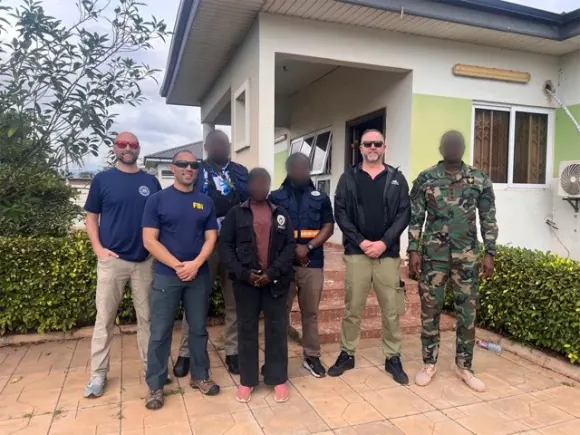
The US Federal Bureau of Investigation (FBI) has announced the successful dismantling of a scam operation in Ghana, yielding significant results in its global campaign against transnational fraud networks targeting American citizens. FBI Director Kash Patel revealed on October 8, 2026, that the operation, part of the bureau's "Operation Blackout" initiative, identified nearly $10 million in losses and 89 victims. The operation resulted in the arrest or detention of over 130 individuals, including victims who will be repatriated to their home countries.
The Ghana operation is part of a broader effort by the FBI to combat scam compounds involved in fraud against Americans. According to Director Patel, "Operation Blackout" has led to the seizure of roughly $17 billion in fraud-related assets, hundreds of arrests, and the freeing of thousands of trafficked workers. The initiative also includes a prevention effort, "Operation Level Up," which has contacted over 10,000 potential victims and prevented hundreds of millions of dollars in losses. These operations highlight the FBI's commitment to disrupting international scam networks.
The scam compounds targeted by the FBI are described as large, fortified facilities where trafficked workers are allegedly forced to conduct fraud against victims abroad. Director Patel noted that criminal networks are increasingly moving their operations towards Africa as law enforcement pressure increases in Southeast Asia and other regions. The FBI's efforts in Ghana reflect growing cooperation between Ghanaian and US authorities over transnational financial and cybercrime.
The announcement comes on the heels of a recent extradition case involving a Ghanaian national, Frederick Kumi, who was extradited to the US in July 2026 to face charges over his alleged involvement in a romance-fraud network. Mr. Kumi, 31, is accused of being part of a network that targeted over 80 elderly victims in the US and allegedly defrauded them of more than $8 million. His extradition was made possible through cooperation between several Ghanaian institutions and US authorities.
The FBI's operation in Ghana involved the seizure of over 300 devices, although the specific Ghanaian institutions involved and the locations of the operations were not disclosed. The investigation remains ongoing, and it is unclear whether those arrested will face prosecution in Ghana or extradition proceedings in the US. Director Patel's announcement concluded with a statement that "More to come," suggesting the bureau's campaign against international scam networks is continuing.
The cooperation between Ghanaian and US authorities is a significant aspect of the efforts to combat transnational financial and cybercrime. Several Ghanaian institutions, including the Attorney-General's Office, the Economic and Organised Crime Office, the Ghana Police Service, the Cyber Security Authority, the National Intelligence Bureau, and the FBI Legal Attaché Office in Accra, were involved in securing Mr. Kumi's arrest and extradition. This cooperation is expected to continue in the fight against scam networks.
The FBI's efforts to disrupt international scam networks have yielded significant results, with "Operation Blackout" and "Operation Level Up" demonstrating the bureau's commitment to protecting American citizens from fraud. The results of the Ghana operation, including the identification of $10 million in losses and 89 victims, highlight the importance of continued cooperation between international law enforcement agencies in the fight against transnational crime.
Key points
- The FBI's "Operation Blackout" initiative has resulted in roughly $17 billion in fraud-related assets being seized.
- The operation in Ghana led to the arrest or detention of over 130 individuals and the seizure of over 300 devices.
- The FBI's efforts in Ghana reflect growing cooperation between Ghanaian and US authorities over transnational financial and cybercrime.