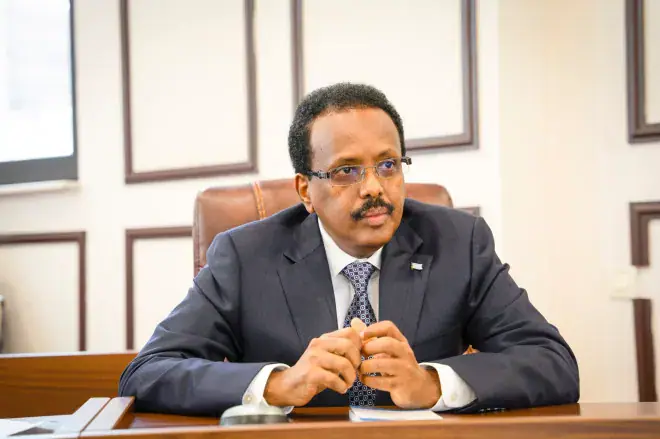
Former Somali President Mohamed Abdullahi Farmaajo has written an open letter to President Hassan Sheikh Mohamud, urging him to initiate an inclusive national dialogue to resolve the country's ongoing election disputes. Farmaajo, who transferred power to Mohamud after the 2022 presidential election, emphasized that Somalia's political disputes should be resolved through dialogue and compromise rather than unilateral decisions. He warned that widening disputes over the constitution, federalism, and political mandates risk further destabilizing the country.
Farmaajo's letter comes amid a continuing dispute over Mohamud's presidential mandate and constitutional changes approved by Somalia's federal institutions. Farmaajo and other opposition figures maintain that Mohamud's four-year term expired in May 2026, while Mohamud rejects that interpretation, citing constitutional changes that extend presidential and parliamentary terms to five years. The government says the amendments establish five-year terms and introduce direct universal suffrage. Farmaajo argued that Somalia's post-conflict political order has depended on four principles: an agreed constitution, completion of the federal system, timely and inclusive elections, and resolving political disagreements through dialogue and compromise.
Farmaajo accused Mohamud's administration of moving away from those principles, citing disputes over the constitution, tensions with federal member states, and disagreements over the electoral process. He also cited recent letters sent to the United Nations by Puntland and other political actors as evidence of growing divisions inside Somalia. Puntland sent a letter to U.N. Secretary-General António Guterres and the Security Council, warning that unresolved disputes over political mandates and federal relations could deepen instability.
The dispute over the constitution and elections is unfolding alongside persistent security concerns, including the threat posed by al-Shabab and uncertainty surrounding international security support. Farmaajo warned that failure to reach a political compromise could damage Somalia's state-building process and deepen disputes between Mogadishu and federal member states. He emphasized that reaching a political agreement on electoral matters is fundamental to the continuity of a legitimate government and the holding of a mutually agreed-upon election.
Farmaajo called for three immediate steps: an inclusive national dialogue, a political agreement on the electoral process, and elections within a short timeframe. He urged Mohamud to use dialogue and compromise to prevent the disputes from worsening, saying such an agreement is necessary to protect Somalia's unity and preserve gains made since the restoration of federal institutions. The letter was released as Mohamud attended the United Nations General Assembly in New York.
The gathering underscored the importance of Somalia presenting progress on its domestic political disputes to international partners. Somalia has faced months of political tension over constitutional changes and the electoral model. The government says the reforms provide the legal framework for direct elections and a five-year presidential term, while Puntland, Jubaland, and several opposition figures have rejected parts of the process and called for a negotiated political settlement.
Farmaajo's appeal is the latest development in a long-standing dispute over the electoral process in Somalia. The country's political disputes have been ongoing for months, with various stakeholders holding different views on the constitutional changes and the electoral model. The situation remains uncertain, with no clear resolution in sight.
Key points
- Former Somali President Mohamed Abdullahi Farmaajo calls for inclusive national dialogue to resolve election disputes.
- Dispute over presidential mandate and constitutional changes continues between Farmaajo and Mohamud.
- Failure to reach a political compromise could damage Somalia's state-building process.