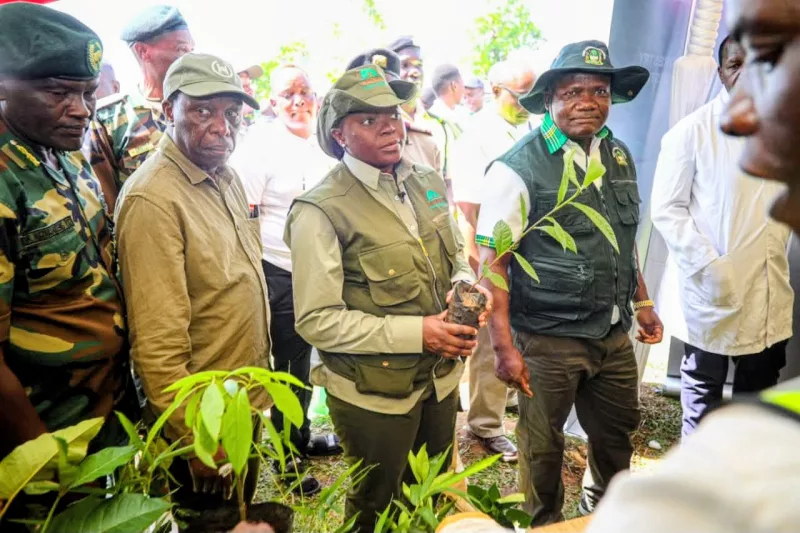
The Kenyan government has announced plans to issue title deeds to families in three settlement schemes in Western Kenya, bringing an end to over four decades of uncertainty. The settlers in the Shiru/Shaviringa, Chebyuk II and III, and Manzini Era settlement schemes occupy land in Kakamega, Mt Elgon and Turbo forests, respectively. This move follows the National Assembly's approval of a petition on June 24, 2026, seeking the variation of boundaries of the three forests.
The National Assembly approved the degazettement of 1,241.5 hectares of Turbo Forest, 4,647 hectares of Mt Elgon Forest, and 130.9 hectares of Kakamega Forest, with a total of 6,018.5 hectares to be excised from the three forests. The land will be used to settle squatters and families who surrendered their parcels to the government for the establishment or expansion of public institutions. Assembly clerk Samuel Njoroge issued certificates for the variation of the forest boundaries on June 25.
The land to be degazetted in the Shaviringa and Shiru areas of Kakamega Forest is occupied by families who were moved into the forest after surrendering their ancestral land around Mbale to the government for the establishment of Vihiga District headquarters in the 1980s. The surrendered land was also used to establish primary and secondary schools, football pitches, markets, a town hall, a cultural centre and a showground. The affected families were to be compensated with alternative land twice the size of the parcels they surrendered.
The first group of families was settled on 53 plots in Shiru sublocation between 1984 and 1985, while the second group was settled on 81 plots in Mukuchi/Shaviringa sublocation between 1994 and 1997. The variation of the Mt Elgon Forest boundaries is intended to regularise the Chebyuk II and III settlement schemes, which are currently occupied by members of the Soy and Dorobo clans of the Sabaot community.
The settlements in Mt Elgon Forest were established in 1974 after the government realised that members of the two clans, particularly those in the Cheptoror and Chepkurkur areas, had encroached on and were squatting on forest land. The degazettement of part of Turbo Forest is intended to settle landless people and squatters in Uasin Gishu county. The area has been surveyed and demarcated into 572 plots.
The government's move to regularise land ownership is expected to bring relief to the families who have been living in uncertainty for decades. The title deeds will provide the families with security of tenure and enable them to access credit and other services. The government has taken a step in the right direction by addressing the historical injustices faced by these families.
The issuance of title deeds is also expected to boost economic development in the region, as families will be able to use their land as collateral to access loans and other financial services. The government's decision has been welcomed by the local communities, who have been waiting for this day for a long time. The implementation of the plan is expected to be completed soon.
Key points
- The Kenyan government has approved the degazettement of 6,018.5 hectares of land from three forests in Western Kenya to settle squatters and families who surrendered their parcels to the government.
- The land will be used to settle families in the Shiru/Shaviringa, Chebyuk II and III, and Manzini Era settlement schemes.
- The title deeds will provide the families with security of tenure and enable them to access credit and other services.