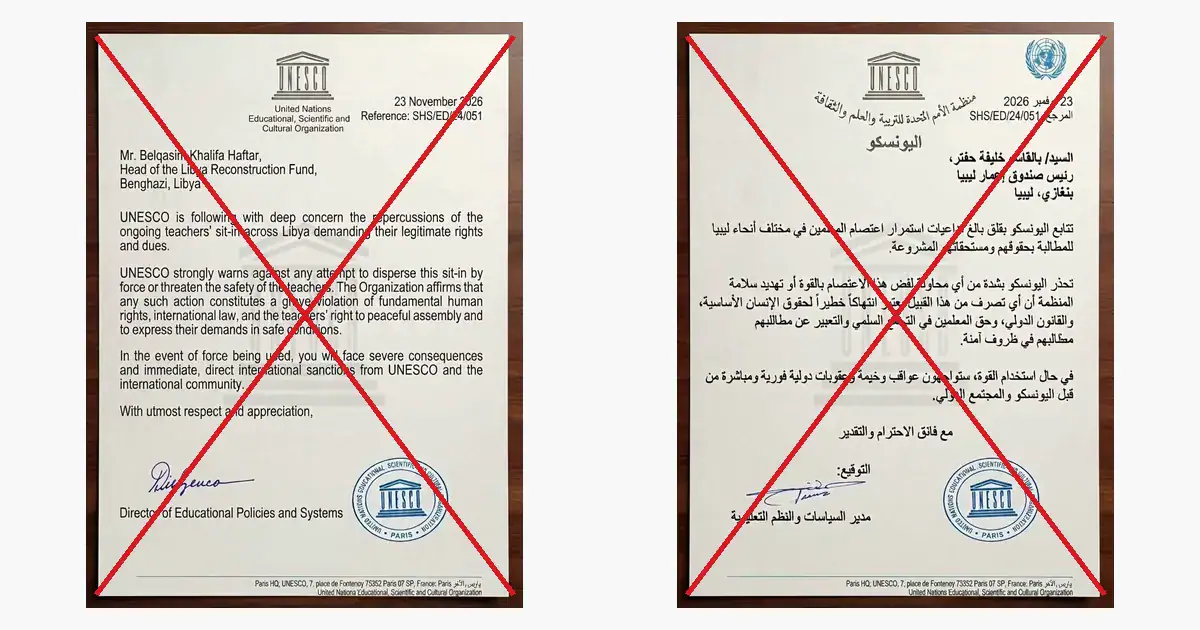
A false message purportedly from UNESCO has been circulating on social media since November 23, 2026, claiming the organization warned Libyan General Khalifa Haftar against using force to disperse a teachers' protest. The message, which has garnered over 374 interactions, 56 comments, and 135 shares, threatens Haftar with international sanctions if he proceeds with the crackdown.
The message, which appears to be a fabrication, contains several inconsistencies and errors. The letterhead and signature of the supposed UNESCO document are inconsistent, with the Arabic and English versions bearing different signatures and job titles. Furthermore, the document contains grammatical errors and inconsistencies in its text, casting doubt on its authenticity.
A thorough examination of the document reveals additional discrepancies. The reference number SHS/ED/24/051 appears to be a mix of codes for different UNESCO sectors, and the date mentioned in the document, November 23, 2026, does not match the reference number, which suggests a 2024 date. Moreover, the UNESCO logo is only present in the Arabic version, not the English one.
The content of the message also raises suspicions. UNESCO's actual role and authority do not include issuing direct international sanctions against individuals or officials. According to its constitution, UNESCO's purposes include promoting cooperation among nations in education, science, culture, and communication, and supporting countries in developing their policies and programs in these areas.
Researchers have checked UNESCO's official channels and Libyan-related information on its website but found no statements or messages regarding the teachers' protest or warnings to Khalifa Haftar. This suggests that the circulating message is likely a fabrication with no basis in fact.
Key differences between the Arabic and English versions of the message, including discrepancies in meaning and grammar, further indicate that the document is not genuine. For instance, the English version threatens the safety of teachers, while the Arabic version confusingly refers to "threatening the safety of the organization."
In conclusion, the investigation concludes that the message circulating online is fake and not affiliated with UNESCO. The organization's structure, roles, and communication channels do not support the claims made in the fabricated message.
Key points
- The message contains several inconsistencies and errors, including different signatures and job titles in the Arabic and English versions.
- UNESCO's actual role and authority do not include issuing direct international sanctions against individuals or officials.
- No statements or messages regarding the teachers' protest or warnings to Khalifa Haftar were found on UNESCO's official channels or Libyan-related information on its website.