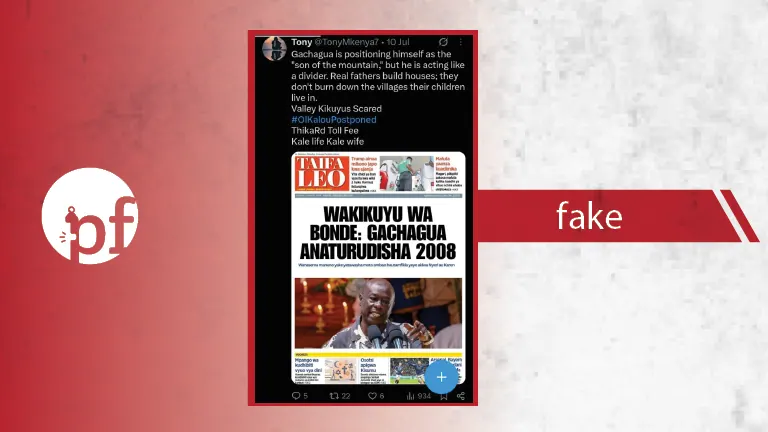
A post on social media features a graphic purporting to be the front cover page of Taifa Leo dated Friday, July 10, 2026. The image displays a photo of former Deputy President Rigathi Gachagua alongside a headline that reads: “Wakikuyu wa bonde: Gachagua anaturudisha 2008” (Kikuyus in Rift Valley: Gachagua is taking us back to 2008). The sub-headline claims: “Wanasema maneno yake yatawasha moto ambao hautamfikia yeye akiwa Nyeri au Karen” (They say his words will ignite a fire that will not reach him while he is in Nyeri or Karen).
The 2007-2008 post-election violence (PEV) in Kenya was a significant event, with the Rift Valley region serving as its primary epicenter. The crisis erupted after the disputed December 27, 2007 presidential election results between the late President Mwai Kibaki (PNU) and the late opposition candidate Raila Odinga (ODM). The Rift Valley, particularly counties like Nakuru, Uasin Gishu, Bomet, and Kericho, is home to a diverse population, including large populations of Kalenjin and Kikuyu communities.
According to findings by the Commission of Inquiry into Post-Election Violence (Waki Commission), the violence in the region was driven by long-standing disputes over land, economic resources, and political dominance between indigenous communities like the Kalenjins and settler populations, predominantly members of the Kikuyu community. The most tragic symbol of this conflict occurred on January 1, 2008, at the Kiambaa Assemblies of God Church near Eldoret, where 28 people, including women and children, were trapped and burned.
Before his impeachment in October 2024, Rigathi Gachagua served as Deputy President. After exiting government and launching the Democracy for the Citizens Party (DCP) in May 2025, Gachagua sought to broaden his political support beyond Mount Kenya. Under the DCP, Gachagua has been conducting extensive grassroots campaign tours across the country, including “Meet the People” tours and town hall meetings across regions like Embu, Meru, and Nyandarua.
Recently, Gachagua expanded his outreach by hosting delegations of local leaders from Rift Valley, including sitting Members of County Assemblies (MCAs) from Nakuru and Laikipia. However, south Rift leaders have accused Gachagua of using divisive rhetoric, alleging that his public speeches and scheduled Democracy for the Citizens Party (DCP) rallies in the region were designed to fuel political hostility and undermine regional peace.
The National Cohesion and Integration Commission (NCIC) issued formal summons ordering Gachagua to appear on August 27, 2026, over alleged inflammatory utterances. Specifically, the commission cited remarks made across multiple forums, including his public use of political metaphors during a Meru tour, Gusii Stadium, and Vihiga County. Verification of the authenticity of the front page image revealed that it was altered by using the real Taifa Leo front page template from July 10, 2026.
The fabricated image was debunked as fake after cross-referencing with Taifa Leo’s official digital archives and verified publishing channels on July 10, 2026. The legitimate edition of Taifa Leo on that date had a headline centered on national infrastructure costs: “TALANTA YATAFUNA MABILIONI” (Talanta Eats Billions). The image alteration involved superimposing a photo of Rigathi Gachagua with the fabricated headline “WAKIKUYU WA BONDE: GACHAGUA ANATURUDISHA 2008” while leaving the surrounding date banner and some of the side stories intact.
Key points
- The image of the Taifa Leo cover page claiming Rift Valley Kikuyus warned Gachagua is taking them back to 2008 is fake.
- The 2007-2008 post-election violence in Kenya resulted in 1,300 deaths and displaced more than 663,921 internally displaced persons (IDPs).
- The National Cohesion and Integration Commission (NCIC) summoned Gachagua to appear on August 27, 2026, over alleged inflammatory utterances.