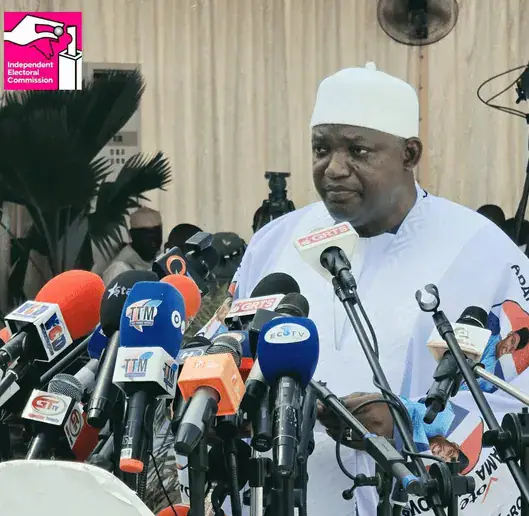
On November 10, 2026, Ghanaian President Adama Barrow submitted his nomination papers to the Independent Electoral Commission, stating that democratic countries like England and Germany have no term limits for their presidents. This claim has raised questions about the constitutional arrangements of these countries and whether their leaders are subject to term limits. According to DUBAWA, a fact-checking organization, Barrow's remarks could mislead, prompting an investigation into the term limits of Germany and the United Kingdom.
Germany is a parliamentary democracy with a Federal Chancellor as head of government and a Federal President as head of state. While the Chancellor has no term limit, serving at the pleasure of the Bundestag, the Federal President faces a limit of two consecutive five-year terms. Article 54(2) of Germany's Basic Law states that the Federal President may be re-elected for only one consecutive term. Angela Merkel served four terms as Chancellor from 2005 to 2021, demonstrating the Chancellor's lack of term limits.
England, part of the United Kingdom, does not have a president, operating instead a constitutional monarchy with a King as Head of State and a Prime Minister as Head of Government. The monarch appoints the Prime Minister, who must command the confidence of the House of Commons. The United Kingdom has no elected president and, consequently, no presidential term limit. Margaret Thatcher held the office of Prime Minister for over 11 years, highlighting the absence of a fixed term limit for the British Prime Minister.
A comparison of the systems reveals that Barrow's claim is accurate but misleading. Neither Germany's Chancellor nor the UK's Prime Minister faces a term limit, but Germany limits its Federal President to two consecutive terms. Both countries operate parliamentary systems, allowing parliament to remove the head of government through various processes. In contrast, The Gambia has an executive presidency with no such checks, making term limits a crucial safeguard.
The Gambia's 1997 Constitution provides that an elected President serves a five-year term, but does not prescribe a maximum number of terms. This means that, unlike Germany, The Gambia does not impose a two-term limit on the presidency. However, The Gambia's president is directly elected and serves as both head of state and head of government, with parliament unable to remove the president through a simple vote of no confidence.
DUBAWA found that Barrow's comparison is misleading due to the differences in the systems of government. While Germany and the UK do not have term limits for their heads of government, The Gambia's executive presidency lacks similar checks. Term limits serve as a safeguard in systems like The Gambia's, highlighting the importance of considering these differences when making comparisons.
In conclusion, President Barrow's claim that democracies like England and Germany have no term limits is misleading. The comparison he draws is not accurate, as the systems of government in these countries differ significantly from The Gambia's. Understanding these differences is crucial in evaluating the role of term limits in various democracies.
Key points
- President Adama Barrow's claim that Germany and England have no presidential term limits is misleading due to the differences in their systems of government.
- Germany's Federal President faces a limit of two consecutive five-year terms, while the Chancellor has no term limit.
- The United Kingdom has no elected president and, consequently, no presidential term limit.