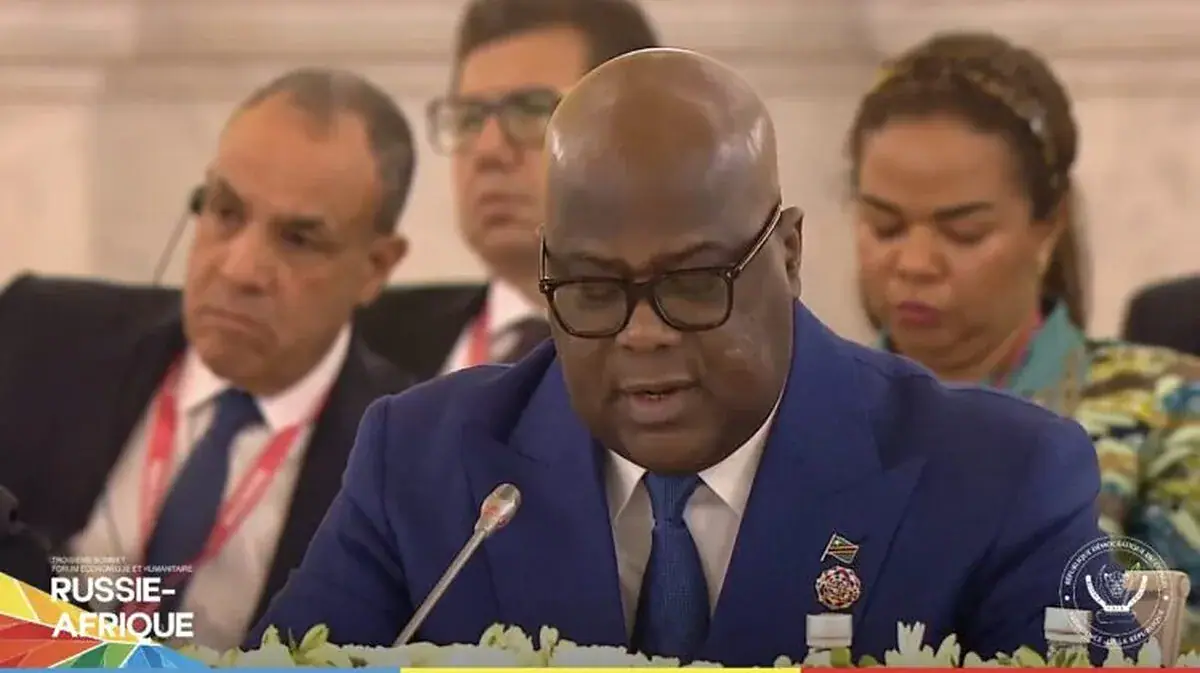
On October 29, 2026, in Moscow, Democratic Republic of the Congo (DRC) President Félix-Antoine Tshisekedi Tshilombo addressed the third Russia-Africa Summit, emphasizing the need for a partnership between Kinshasa and Moscow built on mutual respect, reciprocity, and national interest defense. He thanked Russian President Vladimir Poutine for the invitation and praised the Russian people's hospitality. Tshisekedi called for the summit to produce tangible outcomes for African populations, stressing cooperation must enhance security, create jobs, and amplify Africa's global voice.
Tshisekedi reaffirmed the DRC's diplomatic independence while advocating for strengthened international cooperation to tackle African security, economic, and institutional challenges. He stated that diversifying partnerships does not mean choosing sides but rather reinforcing decision-making freedom in the interest of the population. The DRC seeks to expand its external relations without compromising its judgment autonomy. A multipolar world order where each state can exercise full sovereignty was also advocated for, provided it respects the UN Charter, territorial integrity, and peaceful dispute resolution.
The DRC president highlighted the security situation in the country's East, where he said sovereignty and peace cannot be theoretical. He described daily suffering in conflict-affected areas and criticized links between illicit resource exploitation and ongoing war. Tshisekedi noted that illegally exploited resources finance the war, which in turn prevents development, underscoring a vicious cycle depriving local communities of economic prospects and decent living conditions. The DRC's goal remains establishing durable peace to ensure citizen security and restore state authority nationwide.
Tshisekedi expressed the DRC's commitment to pursuing a diplomatic approach to resolve the Eastern crisis through processes like those in Washington and Doha, in coordination with African Union mediation and support from the US and Qatar. He praised mediators and facilitators but stressed the need for diplomatic progress to translate into tangible, verifiable results on the ground. For Kinshasa, only actual improvements in security and durable peace will be considered real progress. The DRC calls for the implementation of UN Security Council resolutions 2773 and 2808.
These resolutions, adopted unanimously, including by Russia, mandate the cessation of hostilities, M23 withdrawal from occupied areas, and the end of Rwandan Defense Forces' support for M23 and their withdrawal from Congolese territory. Tshisekedi affirmed the DRC's commitment to its obligations and expected equivalent rigor from all concerned parties. He urged Moscow to fully support these decisions' implementation and mediation efforts to end the conflict in Eastern DRC. Protecting civilians, humanitarian access, and the voluntary, safe, and dignified return of displaced persons and refugees were also prioritized.
As the DRC begins its tenure as a non-permanent UN Security Council member for 2026-2027, Tshisekedi vowed to exercise this responsibility independently, seeking balanced solutions to international crises. He advocated for dialogue and diplomacy in conflicts like Ukraine and the Middle East, emphasizing civilian protection. The DRC president noted these conflicts' economic impacts on African populations, including rising food, fertilizer, and energy prices. He championed greater African representation in international decision-making bodies, particularly through Security Council reform to correct what he sees as a historical injustice.
Tshisekedi's speech reflected a broader African demand for a stronger voice in global affairs, aligning with the Ezulwini Consensus and the Sirte Declaration. He expressed a desire to continue dialogue with Russia, aiming for mutually beneficial cooperation that respects national sovereignty and contributes to African and global peace and security. The DRC's active engagement on both regional and global stages underscores its commitment to fostering partnerships that prioritize African interests and aspirations.
Key points
- The DRC seeks concrete partnerships with Russia and other nations based on mutual respect and national interest.
- Tshisekedi emphasizes the need for a multipolar world order that respects sovereignty and territorial integrity.
- The DRC calls for the full implementation of UN Security Council resolutions to address the security crisis in Eastern DRC.